
Axe throwing games are structured activities that test precision, strategy, and group spirit using axes and wooden targets. Most venues accommodate up to 6 people per lane and welcome participants aged 10 and above with adult supervision. The industry term for the broader activity is recreational axe throwing, and the games played within it range from simple scoring rounds to full tournament brackets. Whether your posse is heading out for a birthday, a corporate day, or just a wild Friday night in Newcastle, the right game format makes all the difference between a good session and an unforgettable one.
1. What are the best axe throwing games for beginners?
Simple games are the fastest way to get your gang throwing with confidence. HORSE and Cornhole scoring are the two most recommended formats for newcomers, and both work brilliantly for groups of 2–6 players.
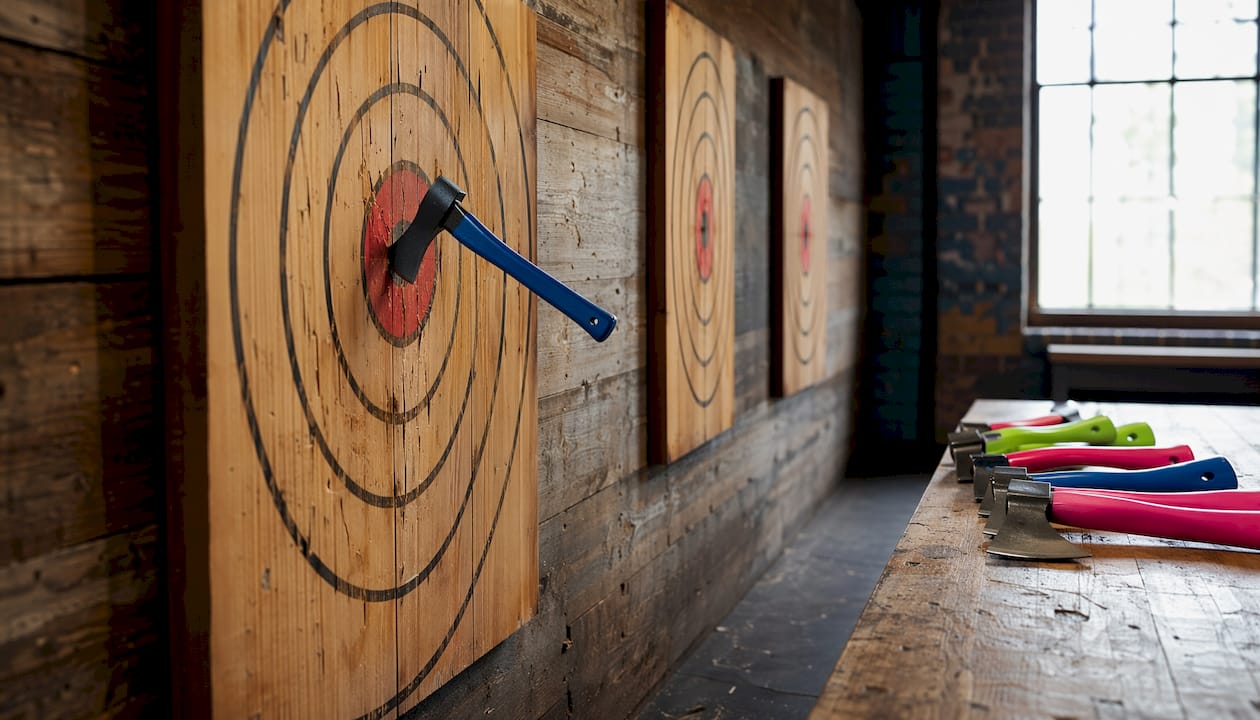
HORSE works exactly like the basketball version. Each player attempts a target zone, and anyone who misses earns a letter. Spell out H-O-R-S-E and you are out. The format rewards consistency over raw power, which suits mixed skill levels perfectly.
Cornhole scoring adapts the classic garden game to the axe range. Players aim for specific rings on the target, with points cancelling out between opponents each round. The running tally keeps everyone invested right to the final throw.
- Both games take under two minutes to explain.
- Neither requires prior axe throwing experience.
- Mixed groups of adults and older teenagers can compete fairly.
- Sessions stay lively because every throw matters.
Pro Tip: Start your session with HORSE for the first two rounds. It builds muscle memory and confidence before your group moves on to anything more competitive.
2. Popular party games to keep larger groups engaged
When your crew grows beyond six, you need games that keep everyone in the action. Formats like Tic-Tac-Toe, Survivor, and Bullseye Relay are built for groups of 4 to 16 players and thrive on noise, cheering, and friendly chaos.
Tic-Tac-Toe divides the target into a nine-zone grid. Two teams alternate throws, trying to claim three zones in a row. Alliances shift, trash talk flies, and the game rarely ends without a dramatic final throw.
Survivor is the crowd favourite at large axe throwing events. Each round, the lowest scorer is eliminated. The last thrower standing wins. The format scales to any group size and keeps spectators just as entertained as participants.
Bullseye Relay splits your group into teams. Each team member throws once, and the scores are combined. It is the ideal format for corporate events because it removes individual pressure and replaces it with collective pride.
Key reasons these games work for parties:
- Rotations keep every player active rather than waiting.
- Team formats reduce anxiety for first-timers.
- Elimination rounds build natural tension and excitement.
- Cheering sections form organically, which lifts the whole room.
Lvls Newcastle is designed precisely for this kind of group energy, with lane setups that support team play and a venue atmosphere that turns a standard evening into a proper occasion.
3. Strategy-driven games for experienced throwers
Once your posse has found its range, basic scoring gets stale fast. Adding strategic games like Cricket or 21 adds the variety and challenge that keeps experienced players locked in.
Cricket mirrors the dart game of the same name. Players must "close" target zones by hitting each one three times before their opponent does. Closing a zone scores points; your opponent can cancel them by closing it themselves. The result is a tactical duel that rewards precision and reading your rival's game plan.
21 (Blackjack) is deceptively simple. Players accumulate points and try to reach exactly 21. Go over and you bust back to 13. The scoring tension is immediate, and the decision to throw conservatively or go for a high-value bullseye creates genuine drama every round.
Landmines adds a twist by designating certain zones as penalties. Hit one and you lose points. The game forces throwers to aim deliberately rather than just throwing hard.
Strategic elements that change gameplay dynamics:
- Zone ownership in Cricket creates defensive and offensive decisions.
- Bust mechanics in 21 punish greed and reward patience.
- Penalty zones in Landmines demand accuracy under pressure.
- All three games extend session length naturally without feeling forced.
Pro Tip: A controlled, rhythmic throwing motion beats brute force every time. Consistency is the real weapon in strategy games where every point counts.
4. How to organise axe throwing tournaments and competitions
A well-run tournament turns a group activity into a proper event. The three standard formats are single elimination, double elimination, and round robin, and each suits a different group size and time budget.
Single elimination is the quickest. Lose once and you are out. It works for groups of 8–16 players and wraps up within an hour. The downside is that early losers spend a lot of time watching.
Double elimination gives every player a second chance. Losers drop into a consolation bracket and can still reach the final. The format suits groups who want everyone involved for longer, though it adds roughly 30–40 minutes to the schedule.
Round robin has every player or team face every other. The player with the most wins takes the title. It is the fairest format but requires the most time and works best for smaller groups of 4–8.
| Format | Best group size | Approximate duration | Key benefit |
|---|---|---|---|
| Single elimination | 8–16 players | 45–60 minutes | Fast and decisive |
| Double elimination | 8–16 players | 75–90 minutes | Everyone gets a second chance |
| Round robin | 4–8 players | 60–90 minutes | Fairest overall result |
Standard WATL scoring awards 1 point for the outer ring, 2 for the middle, 3 for the inner, 5 for the bullseye, and 7 for the killshot. That scoring structure rewards skill without making casual players feel hopeless.
Defining tiebreaker rules before the tournament starts is non-negotiable. A single deciding bullseye throw is the cleanest resolution and avoids disputes mid-event. For corporate or large events, running matches across multiple lanes simultaneously keeps the whole tournament within a 1–2 hour window.
5. How to choose the right game for your occasion
Not every game suits every group. Matching the format to the occasion is what separates a great session from a frustrating one.
| Occasion | Recommended game | Why it works |
|---|---|---|
| Beginners or first-timers | HORSE or Cornhole scoring | Low pressure, easy to learn, suits all skill levels |
| Large parties (10+ people) | Survivor or Bullseye Relay | Scales well, keeps everyone active |
| Corporate team events | Bullseye Relay or round robin | Builds teamwork, reduces individual pressure |
| Date nights or pairs | 21 (Blackjack) or Cricket | Intimate, tactical, and naturally competitive |
| Experienced groups | Cricket, Landmines, or tournament brackets | Adds depth and sustained challenge |
Bracket-style tournaments suit groups of 8–16 players for sustained engagement. Smaller groups of 2–4 get more out of head-to-head formats like Cricket or 21, where every throw carries individual weight.
The golden rule is to start accessible and escalate. Open with HORSE, move to a team relay, and finish with a knockout bracket. Your group will thank you for the pacing.
Key takeaways
The most effective axe throwing session mixes beginner-friendly formats, party games, and strategy rounds to keep every player engaged from first throw to last.
| Point | Details |
|---|---|
| Start with simple games | HORSE and Cornhole scoring build confidence and suit all skill levels. |
| Scale up for large groups | Survivor and Bullseye Relay keep 10+ players active and entertained. |
| Add strategy for experienced players | Cricket and 21 extend sessions and reward precision over power. |
| Plan tournaments carefully | Choose your format, set WATL scoring rules, and define tiebreakers before you start. |
| Match the game to the occasion | Pair the format to your group size and event type for the best experience. |
Why mixing game formats is the real secret
Here is something most articles on recreational axe throwing miss entirely. The game format matters more than technique for group enjoyment. I have watched groups of complete beginners have an absolute blast with HORSE, and I have seen experienced throwers lose interest within twenty minutes because nobody switched up the format.
Experienced groups shift from standard scoring after round three to meta-games like HORSE, Cricket, or brackets to sustain engagement. That is not a coincidence. It reflects how human attention works in competitive social settings. Novelty keeps energy high.
The other thing worth saying plainly: technique and play are not separate things. A controlled, rhythmic motion is what makes axes stick consistently, and end-grain targets are what make that sticking satisfying. When the axe buries itself cleanly, the whole group reacts. That reaction is the social glue of the activity.
My honest advice: plan three game formats before you arrive. Start easy, go loud and team-based in the middle, and finish with something tactical. Your session will have a natural arc, and nobody will want to leave when the time is up.
— Escape
Axe throwing in Newcastle: book your session at Lvls Newcastle
Lvls Newcastle brings all of this to life in one venue in the heart of Newcastle upon Tyne. The axe throwing experience includes expert coaching from the first throw, so your group builds real technique fast. Safety standards are clear: close-toed shoes are required, and professional coaching helps beginners achieve early success. Lanes accommodate groups up to 6, and the team can advise on the best game formats for your occasion.

Whether you are planning a birthday, a corporate outing, or a spontaneous night out with your posse, Lvls Newcastle has the space, the kit, and the know-how to make it memorable. Book your adventure and find out why groups keep coming back for more.
FAQ
What are the easiest axe throwing games for beginners?
HORSE and Cornhole scoring are the most beginner-friendly formats. Both take under two minutes to explain and work well for mixed skill levels.
How many people can play axe throwing at once?
Most venues accommodate up to 6 people per lane. Larger groups can run across multiple lanes simultaneously to keep everyone active.
What scoring system do axe throwing tournaments use?
The WATL scoring system awards 1 point for the outer ring, 2 for the middle, 3 for the inner, 5 for the bullseye, and 7 for the killshot.
What is the best axe throwing game for a corporate event?
Bullseye Relay and round robin formats work best for corporate groups. Both build teamwork and reduce individual pressure, making them inclusive for all skill levels.
How long does an axe throwing tournament take?
Single elimination tournaments for 8–16 players typically finish in 45–60 minutes. Running matches across multiple lanes keeps large-group events within a 1–2 hour window.