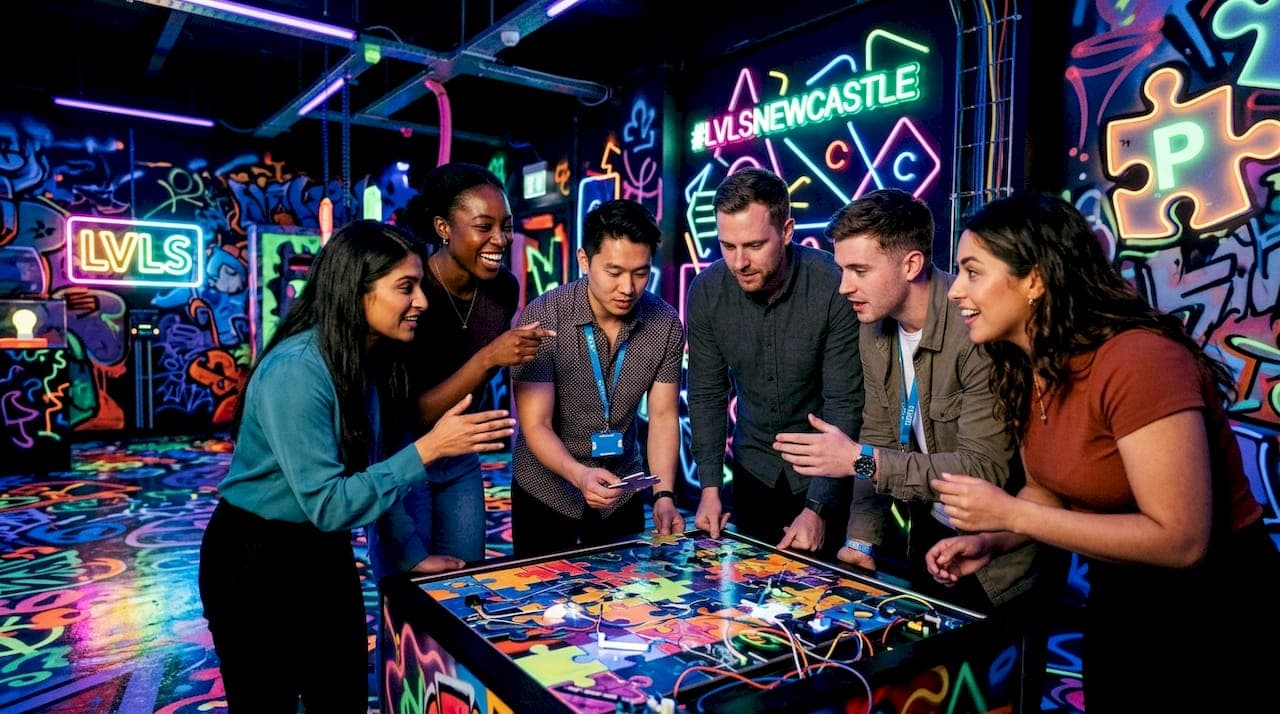
A team building escape room is an immersive, timed challenge where colleagues must communicate, delegate, and solve puzzles together to "escape" within a set period. Unlike passive workshops or awkward icebreakers, escape rooms force immediate communication and problem-solving that directly mirrors workplace pressure. Your posse gets 60 minutes to wrangle the clues, and every single person must pull their weight. Sessions typically run 60 minutes with the full event lasting 1.5 to 3 hours, accommodating groups from 2 to 50 participants in person. That scalability makes escape room team challenges one of the most flexible corporate team building activities available to HR professionals in Newcastle upon Tyne and beyond.
What makes a team building escape room work for corporate groups?
The core mechanic is simple: no lone ranger wins this game. Every puzzle demands that your team share information, assign tasks, and trust each other's judgement under pressure. That pressure is the point. It strips away office hierarchy and forces organic collaboration in a way that a conference room never could.
Immersive escape rooms break down workplace hierarchies and engage every team member equally. A quiet analyst who never speaks up in meetings might crack the critical cipher. A senior manager might find themselves taking direction from a junior colleague. Those role reversals build genuine respect that carries back to the office.
The format also mirrors real project work. Your team faces an unknown problem, limited resources, and a hard deadline. The skills they use to escape are the same skills they need to deliver a product launch or manage a client crisis. That direct parallel is why group escape room activities have become a staple of corporate development programmes across the UK.
How to plan a successful escape room corporate event
Before your posse rides into the room, solid preparation makes the difference between a memorable experience and a chaotic afternoon.
Key requirements at a glance
| Requirement | Typical standard |
|---|---|
| Group size | 2–50 in-person participants |
| Session length | 60-minute game; 1.5–3 hours total |
| Booking lead time | At least one business day for quotes |
| Venue space | Private room plus debrief area |
| Pricing structure | Customised by group size and add-ons |
Pricing is fully customised based on group size, catering add-ons, and venue logistics, with most providers responding to quote requests within approximately one business day. That means you should contact your venue at least a week in advance to allow time for back-and-forth on packages.
Here is what to confirm before you book:
- Private rooms. Shared spaces with strangers undermine the team dynamic. Insist on exclusive use.
- Debrief space. A private post-game meeting area extends the event and turns fun into learning. Ask whether the venue provides one.
- Catering options. Food and drink before or after the game extend the social bonding window significantly.
- Accessibility. Confirm the venue suits all mobility and sensory needs within your group.
- Customisation. Ask whether the narrative or difficulty can be adjusted to match your team's experience level.
Pro Tip: Brief your team before the day. A short note explaining the format, dress code, and purpose of the event reduces anxiety and increases engagement from the first minute.
How to run escape room team challenges step by step
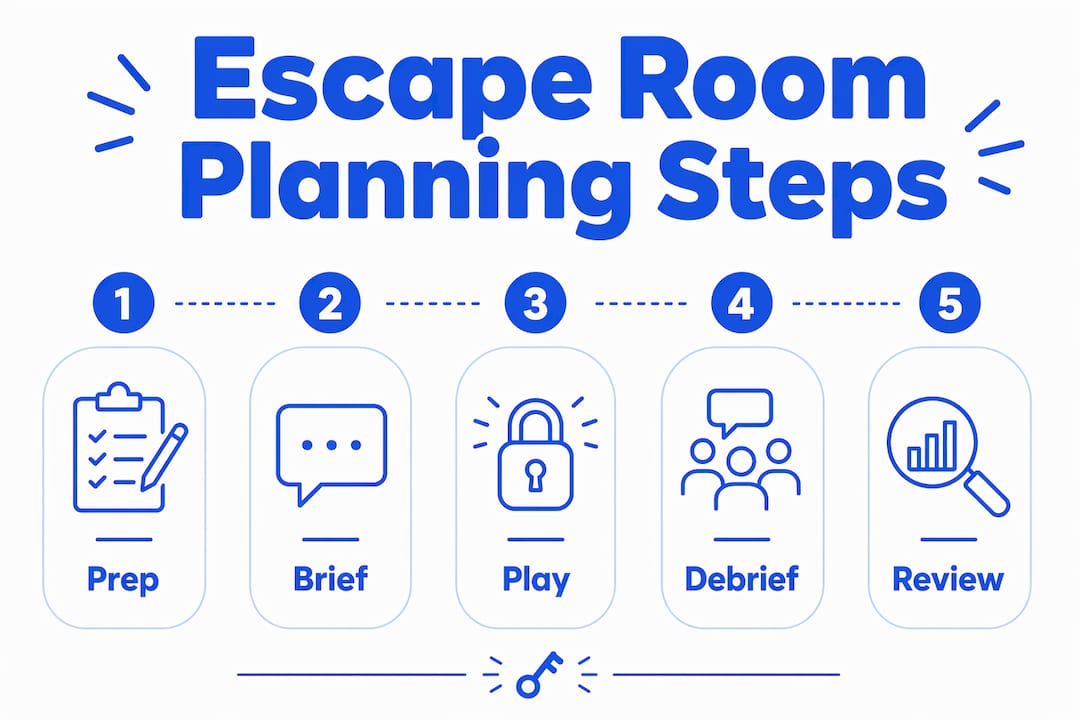
Getting the most from your group escape room activity requires more than just showing up. Follow this sequence to maximise both enjoyment and developmental impact.
-
Arrive early and set expectations. Give your group 15 minutes before the game to settle, switch off work mode, and hear a clear briefing. Explain that the goal is collaboration, not competition.
-
Let the game master brief the rules. Listen carefully. The game master's instructions contain clues about how the room is structured. Teams that pay attention during the briefing solve puzzles faster.
-
Spread out immediately. When the clock starts, resist the urge to huddle. Split into pairs and scan the room systematically. Call out every object, symbol, or anomaly you find.
-
Communicate findings aloud. The most common mistake is solving a clue silently and moving on. Every discovery must be shared with the whole group. One person's clue is another person's answer.
-
Allow leadership to emerge naturally. Assigning rigid roles before gameplay stifles spontaneous leadership and collaboration. Let the person best suited to each puzzle step forward organically.
-
Manage multi-room formats with delegation. Multi-room formats require delegation because no individual can be in two places at once. Appoint a communication lead whose only job is to relay information between rooms.
-
Use hints wisely. Most venues offer a set number of hints. Save them for genuine blockages, not impatience. Deciding when to ask for help is itself a team skill worth practising.
-
Run a structured debrief. Post-game debriefs lasting 60–120 minutes transform the game into a developmental tool. Ask three questions: What worked well? What slowed us down? What would we do differently at work?
Pro Tip: Assign one person to observe rather than play during the first 10 minutes. Their outside perspective during the debrief is often the most revealing insight of the entire event.
What skills do escape rooms build in your team?
The skills your team develops during an interactive team building experience are directly transferable to everyday work. Here is what the research shows:
- Communication. Every puzzle requires constant, purposeful dialogue. Teams that go quiet lose. That habit of speaking up under pressure carries directly into project meetings and client calls.
- Leadership emergence. Real collaboration reveals genuine leadership skills beyond scripted roles. The colleague who organises the room search or rallies the group when morale dips is showing you exactly who your natural leaders are.
- Delegation. Larger groups and multi-room formats make delegation non-negotiable. Teams learn quickly that hoarding tasks leads to failure, and that trusting colleagues with responsibility is the fastest route to success.
- Problem-solving under pressure. The ticking clock creates genuine stress. Working through that stress together builds resilience and teaches teams to think clearly when deadlines loom.
- Trust. Shared challenge builds shared memory. Teams that escape together report stronger working relationships and greater willingness to ask for help back at the office.
"The strongest escape room team building experiences combine immersive fun with structured leadership coaching and tailored agendas aligned with corporate goals. When you pair the game with a Gallup-certified Strengths Coach during the debrief, you transform a fun afternoon into a genuine growth event."
Incorporating Gallup-certified coaching during the debrief maximises leadership learning post-game. Not every venue offers this, but asking your provider about facilitated debrief options is always worth the conversation.
How to handle scepticism and keep every player engaged
Not everyone in your posse arrives at the high noon saloon ready to play. Some colleagues view team building with suspicion, particularly those who prefer independent work. The good news is that escape rooms are uniquely effective at lowering those defences.
Escape rooms lower participant defences and increase natural participation compared to typical icebreakers. The immersive environment does the heavy lifting. Once the clock starts, even the most reluctant participant tends to get drawn in by the puzzle itself rather than the social pressure.
Common challenges and how to solve them
| Challenge | Solution |
|---|---|
| Reluctant participants | Frame the event as a fun challenge, not a training exercise |
| Solo workers pulling away | Facilitators should encourage them to share findings aloud |
| One person dominating | Introduce a "one idea at a time" communication rule during briefing |
| Team losing momentum | Use a hint strategically to re-energise the group |
| Post-game resistance to debrief | Keep debrief conversational, not evaluative |
Effective facilitators actively observe communication patterns and encourage isolated participants without taking over the game. Your role as the organiser is to watch, not to lead. The most valuable data you collect is who communicates with whom, and who goes quiet when the pressure rises.
Pro Tip: After the game, open the debrief with a light question: "What was the funniest moment?" Laughter lowers defences and makes the deeper reflection that follows feel natural rather than forced.
Key takeaways
A team building escape room delivers the most value when immersive gameplay is paired with a structured debrief and clear developmental goals set before the event.
| Point | Details |
|---|---|
| Plan ahead | Book at least one week in advance and confirm private rooms and debrief space. |
| Let leadership emerge | Avoid assigning rigid roles; organic leadership reveals genuine team strengths. |
| Debrief thoroughly | Run a 60–120 minute post-game discussion to convert fun into workplace learning. |
| Manage quiet participants | Facilitators should actively encourage solo workers to share findings with the group. |
| Match format to group size | Use multi-room formats for larger teams to practise delegation and trust. |
Why I think most teams leave value on the table
Most corporate groups treat the escape room as the main event. They book the room, play the game, and head to the pub. That is a missed opportunity of the highest order.
The game itself is the warm-up. The real work happens in the debrief. I have seen teams walk out of a 60-minute room buzzing with energy, then sit in silence for a 10-minute "chat" that covers nothing of substance. All that rich data about who led, who withdrew, and who thrived under pressure simply evaporates.
The teams that get the most from these experiences treat the debrief as a coaching session. They ask hard questions. They name specific moments. They connect what happened in the room to what happens in the office every Monday morning. That connection is where the lasting change lives.
My other observation is about role assignment. Planners often want to control the experience by assigning team captains or task leads before the game starts. Resist that urge. The whole point of a problem solving escape room is to see who steps up when the situation demands it. Scripting that removes the most valuable data you will collect all year.
Escape rooms work because they are genuinely fun. Do not over-engineer them. Book the room, set the context, play hard, and then debrief with intention. That combination, done well, builds the kind of team trust that no workshop ever could.
— Escape
Lvls Newcastle: escape room adventures built for your team
Your team deserves more than a generic afternoon out. Lvls in Newcastle upon Tyne offers private escape rooms designed for corporate groups, with themed challenges that suit a range of skill levels and group sizes. Whether your posse is a tight-knit squad of six or a full department, Lvls has a format that fits.
Beyond the escape rooms, Lvls brings axe throwing, a board game café, and interactive darts under one roof, giving your team a full day of bonding options. Customisable packages make it straightforward to build a programme that matches your goals and budget. Book your team's adventure and give your colleagues a shared experience they will still be talking about at the next all-hands meeting.
FAQ
How long does a corporate escape room event last?
A typical session runs 60 minutes, with the full event including briefing and debrief lasting between 1.5 and 3 hours. Plan for the longer end if you intend to run a structured post-game discussion.
How many people can take part in a team building escape room?
Most in-person escape room formats accommodate between 2 and 50 participants. Larger groups benefit from multi-room formats that encourage delegation across sub-teams.
Do escape rooms actually improve workplace skills?
Yes. Escape rooms require 100% active engagement and directly simulate workplace challenges including communication, delegation, and problem-solving under pressure. The skills transfer is strongest when paired with a structured debrief.
Should I assign team roles before the escape room starts?
Avoid it. Organic role emergence produces greater team effectiveness than pre-assigned roles, and reveals natural leaders you might not have identified through standard performance reviews.
How do I handle employees who are reluctant to participate?
Frame the event as a fun challenge rather than a training exercise. Immersive environments naturally lower resistance, and a skilled facilitator can draw quieter participants into the group without applying social pressure.