
Blood on the Clocktower is the best social deduction game for groups that want depth, drama, and zero boredom for eliminated players. For a quick reference, here are the top picks your posse needs to know:
- Best overall: Blood on the Clocktower — best with 8–30+ players; ghost mechanics keep dead players in the hunt long after they fall.
- Best party pick: The Chameleon; rounds last roughly five minutes and anyone can play from the first hand.
- Best for small groups: Coup; a brief bluffing duel that rewards sharp instincts and punishes overconfidence (recommended for 2–6 players).
- Best for 8+ players: Secret Hitler — 5–10 players; available free as a print-and-play under a Creative Commons licence, with sessions running 20–45 minutes.
- Best heavy/strategic pick: Unfathomable; traitors hide in shared resource flows rather than obvious betrayals, so the real skill is reading the numbers.
- Best for very large groups: Two Rooms and a Boom; scales to very large groups and turns an entire room into the game board.
Social deduction games are built on hidden roles and the art of reading your fellow gunslingers. The genre traces back to Mafia in 1986, ran through Werewolf, and exploded into mainstream culture with Among Us. The tabletop versions remain the sharpest, most social form of the genre — and the right pick depends almost entirely on how many riders are in your posse.
Pro Tip: Before your gang sits down, count heads. Games like Ultimate Werewolf and Blood on the Clocktower genuinely need eight or more players to fire on all cylinders (Blood on the Clocktower is best with 8–30+). Coup is recommended for 2–6 players, and Love Letter also shines in that range.
Table of Contents
- The best social deduction board games: full comparison and verdicts
- How to pick the right social deduction game for your group
- Playtest notes: what actually changes with player count
- Where to buy or play these games in the UK
- Key takeaways
- Why the best pick is never just about the game
- Play social deduction games at Lvls Newcastle
- Further reading and authoritative sources
The best social deduction board games: full comparison and verdicts
| Game | Best for | Player count | Play time | Complexity | Eliminated players | Moderator needed | UK price (approx.) | Replayability |
|---|---|---|---|---|---|---|---|---|
| Blood on the Clocktower | Large strategic groups | Suitable player counts | Typical playtime | High complexity | Ghost roles stay active | Yes | Price range available | Exceptional replayability |
| Secret Hitler | Mid-size groups / party | Suitable player counts | Moderate playtime | Low–Medium complexity | Sit out | No | Price range available | Very high replayability |
| The Resistance / Avalon | Dedicated hobby groups | Suitable player counts | Moderate playtime | Medium complexity | Sit out | No | Price range available | Very high replayability |
| Coup | Small groups / quick play | Suitable player counts | Short playtime | Low complexity | Eliminated quickly | No | Price range available | High replayability |
| Ultimate Werewolf | Large event nights | Suitable player counts | Moderate playtime | Medium complexity | Sit out (long wait) | Yes | Price range available | High replayability |
| One Night Ultimate Werewolf | Quick filler / 5–10 | Suitable player counts | Short playtime | Low complexity | No elimination | No | Price range available | High replayability |
| Deception: Murder in Hong Kong | Mid-size puzzle lovers | Suitable player counts | Moderate playtime | Medium complexity | Sit out | No | Price range available | High replayability |
| Spyfall | Casual party groups | Suitable player counts | Moderate playtime | Low complexity | Sit out | No | Price range available | High replayability |
| The Chameleon | Party filler / mixed skill | Suitable player counts | Moderate playtime | Very low complexity | No elimination | No | Price range available | High replayability |
| Two Rooms and a Boom | Very large gatherings | Suitable player counts | Moderate playtime | Low–Medium complexity | No elimination | Yes | Price range available | High replayability |
| Werewords | Family / party | Suitable player counts | Short playtime | Very low complexity | No elimination | No | Price range available | Medium replayability |
| Obscurio | Families / co-op fans | Suitable player counts | Moderate playtime | Medium complexity | Sit out | No | Price range available | Medium–High replayability |
| Love Letter | Small groups / travel | Suitable player counts | Short playtime | Very low complexity | Eliminated quickly | No | Price range available | High replayability |
| Saboteur / Saboteur 2 | Casual / mixed age | Suitable player counts | Moderate playtime | Low complexity | Sit out | No | Price range available | Medium–High replayability |
| Bang! The Dice Game | Casual party | Suitable player counts | Moderate playtime | Low complexity | Sit out | No | Price range available | Medium replayability |
| Dead of Winter | Story-driven hobby groups | Suitable player counts | Long playtime | High complexity | Sit out | No | Price range available | High replayability |
| Mascarade | Mid-size mixed groups | Suitable player counts | Moderate playtime | Low–Medium complexity | Sit out | No | Price range available | Medium replayability |
| A Fake Artist Goes to New York | Creative party nights | Suitable player counts | Moderate playtime | Very low complexity | No elimination | No | Price range available | High replayability |
| Unfathomable | Strategic hobby groups | Suitable player counts | Long playtime | Very high complexity | Sit out | No | Price range available | High replayability |
Pro Tip: Print the comparison table and stick it on the fridge before game night. Matching player count to the right game is the single biggest factor in whether the night flies or drags.
Blood on the Clocktower
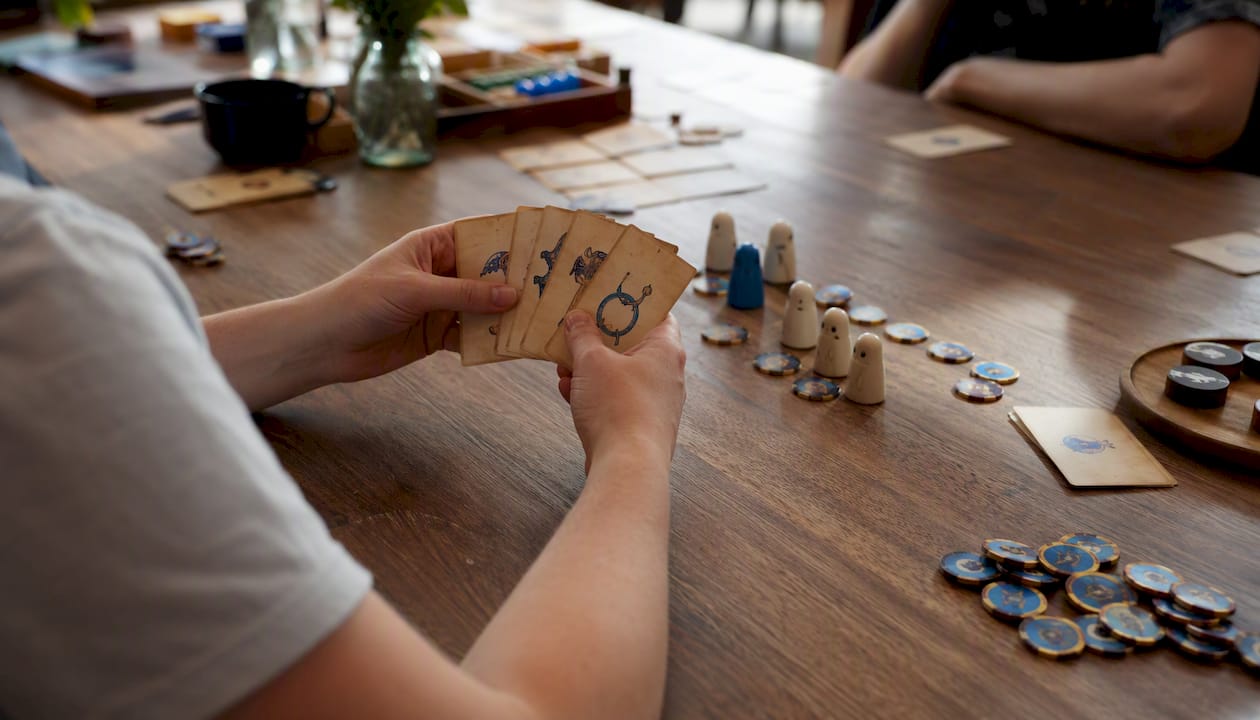
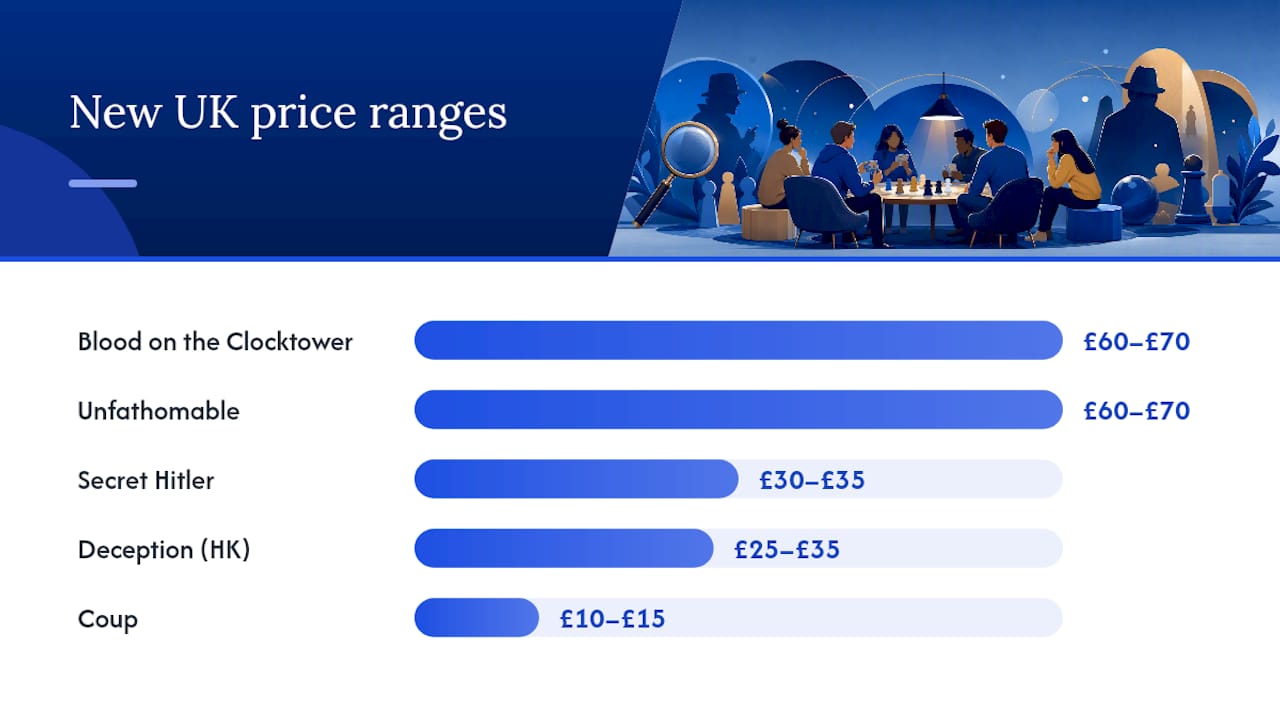
The gold standard for groups who want a full evening of social theatre. The storyteller role gives one player the job of running the night phase, which means the game never stalls waiting for a moderator to catch up. Dead players receive ghost tokens and keep voting, so nobody is sitting on the sidelines nursing a cold drink while the living argue. It plays best at 12–15 players, though it functions from five. The price point (around £60–£70 in the UK) is steep, but the box contains enough roles to run hundreds of distinct sessions.
Secret Hitler
Simple enough to teach in three minutes, tense enough to fracture friendships. The policy-track mechanic forces players to vote on legislation, which means even cautious players cannot stay quiet for long. Secret Hitler is available free as a print-and-play under a Creative Commons licence, making it the most accessible entry point in the genre. The physical edition runs £30–£35 from UK hobby retailers. One common pitfall: with exactly five players, the fascist team has a significant information advantage, so six or more is the sweet spot.
The Resistance / Avalon
The Resistance strips social deduction to its bones: propose a mission team, vote, succeed or fail, repeat. Avalon adds Arthurian roles (Merlin, Percival, the Assassin) that layer in extra deduction without bloating the rules. Both versions play best at six to eight, where the information asymmetry between the resistance and the spies feels genuinely balanced. No moderator required, no night phase, no downtime. The Avalon edition is the one most UK hobby groups reach for first.
Coup
Fifteen minutes, two cards, and a table full of liars. Coup is the fastest rotation game in the genre — you challenge, bluff, or fold, and the round is done before anyone has time to overthink it. Rounds run roughly 15 minutes, which makes it perfect as a warm-up before a heavier game or as a last-round filler when the group is flagging. Available in most UK game shops for £10–£15.
Ultimate Werewolf
The classic large-group game, and still the best option when your posse swells past fifteen. A moderator runs the night phase, calling roles one by one while everyone else keeps their eyes shut. The downside is real: eliminated players can wait a long time before the next round begins, especially in a long game. The fix is to run shorter games with fewer roles, or to switch to One Night Ultimate Werewolf for groups under ten. One Night removes elimination entirely — every player survives to the vote, and the whole round wraps in ten minutes.
Deception: Murder in Hong Kong
One player is the forensic scientist, laying out clue tiles in silence while the murderer tries to misdirect the investigators. The clue-giving mechanic channels discussion in a way that feels genuinely different from pure voting games. It plays cleanly at six to eight and handles up to twelve without losing pace. Widely available in UK hobby shops for £25–£35.
Spyfall
One player is the spy; everyone else knows the location. The game is entirely conversational — players ask each other questions, trying to expose the spy without accidentally revealing the location to them. Rounds are fast and the learning curve is almost flat. The DC Spyfall variant swaps locations for DC Comics settings, which works well for groups who find the base game's location list a bit dry after repeated plays.
The Chameleon
Word association with a hidden fake. All players see the secret word except the Chameleon, who must bluff their way through by giving a plausible one-word clue. Rounds last about five minutes, the rules fit on a single card, and it works for mixed-age groups from about ten years old upwards. One of the best party filler picks in the genre.
Two Rooms and a Boom
Split your group into two rooms, shuffle the roles, and spend three rounds trading hostages and gathering information before the final reveal. The two-room mechanic means players are physically moving and talking, which makes it feel less like a board game and more like a live social experiment. It scales to thirty or more players, making it the go-to for large parties, office events, or any gathering where a table-based game simply will not fit.
Werewords and Werewords Deluxe Edition
A word-guessing game wearing a werewolf costume. One player knows the secret word and gives yes/no answers; hidden roles determine who is trying to help and who is trying to derail. Rounds take ten minutes and the rules are simple enough for families. The Deluxe Edition adds extra role cards and a sturdier app integration. Both versions are widely available in the UK for £15–£20.
Obscurio
A cooperative picture-book game with a traitor hiding inside the team. The grimoire master gives visual clues by pointing to elements in illustrated tableau cards, while the traitor subtly nudges the group towards wrong answers. The visual clue system makes it accessible for players who find pure deduction games intimidating, and the cooperative framing keeps the atmosphere lighter than most traitor games.
Love Letter
Sixteen cards, two to six players, and a game that fits in a coat pocket. Love Letter is not a full social deduction experience, but its process-of-elimination mechanic teaches the core skill of deducing hidden information from visible actions. The perfect travel companion or warm-up game for a group new to the genre. Recommended for 2–6 players.
Saboteur and Saboteur 2
Dwarves digging tunnels, with hidden saboteurs blocking the path. Saboteur plays three to twelve players and handles mixed-age groups well because the tunnel-building mechanic is immediately intuitive. Saboteur 2 adds new roles and a third faction, which extends the life of the base game considerably. Both editions are available in UK shops for £10–£20.
Dead of Winter
A semi-cooperative survival game where players share a colony objective but each hold a secret personal goal that may or may not align with the group's survival. The Crossroads card system generates narrative moments that make every session feel different. Sessions run 60–120 minutes, so this is a commitment — but for story-driven hobby groups, it is one of the richest experiences in the genre.
Mascarade
Up to thirteen players swap role cards face-down, bluff about their identity, and try to accumulate enough gold to win. The memory element is the twist: after several swaps, even you might not know what role you are holding. It plays quickly and handles large groups, though it can feel chaotic with players who dislike uncertainty.
A Fake Artist Goes to New York
Everyone draws one line on a shared picture. One player is the fake artist and has no idea what the subject is. The game is creative, fast, and accessible to anyone who can hold a pen. It works beautifully as a party opener for mixed groups and requires no reading ability, making it one of the most genuinely family-friendly picks in this list.
Unfathomable
The heaviest game here by a considerable margin. Unfathomable uses shared resource management to conceal traitor actions, so the deduction is less about reading faces and more about tracking whether the ship's food supply is depleting faster than it should. Sessions run two to three hours, and the rulebook demands a committed teach. For strategic hobby groups who want their social deduction wrapped in a full narrative engine, it is unmatched in the genre.
Other titles worth knowing
Several games in the genre deserve a mention without requiring a full entry. Tortuga 1667 is a pirate-themed traitor game for 2–9 players that plays in under thirty minutes. Hail Hydra brings Marvel theming to a Resistance-style format and works well for comic fans. Battlestar Galactica: The Board Game is a heavier traitor game with strong thematic integration, though it has been out of print for some time in the UK. Shadows over Camelot is a cooperative game with an optional traitor mechanic that suits groups who prefer lighter suspicion. Revolution! uses bidding mechanics to hide allegiances. Escape from the Aliens in Outer Space is a grid-movement hidden-role game that plays in near-silence. Nosferatu and Mayday!Mayday! are compact cooperative-traitor titles. A Study in Emerald (Second Edition) layers Lovecraftian and Holmesian theming over a complex hidden-faction engine. Leaders of Euphoria: Choose a Better Oppressor and Crossfire are lighter faction games. Don't Mess with Cthulhu Deluxe, DC Spyfall, Patriots & Redcoats, and Game of Thrones: Oathbreaker each offer themed variants of core mechanics already covered above. Werewolf is the original public-domain version of the genre, requiring no components at all.
How to pick the right social deduction game for your group
The single most important question is how many riders are in your posse. Get that right and everything else follows.
The decision checklist
- 5–8 players: — Secret Hitler, The Resistance / Avalon, Spyfall, or Deception: Murder in Hong Kong. The information asymmetry in these games needs at least five to feel balanced.
Key factors beyond player count
Tolerance for elimination is the second biggest variable. Games like Ultimate Werewolf eliminate players early and keep them out for the rest of the round, which can mean twenty minutes of watching from the sidelines. If your group includes players who disengage quickly, choose One Night Ultimate Werewolf, The Chameleon, or Two Rooms and a Boom, where nobody is ever fully removed from play.
Moderator requirement matters more than most buyers realise. Blood on the Clocktower and Ultimate Werewolf both need one player to run the night phase, which means that player is not fully participating in the social deduction. For groups where everyone wants to play, moderator-free games like Secret Hitler or The Resistance are a better fit.
Price and print-and-play options vary widely. Secret Hitler is free to print, Coup costs around £10–£15, and Blood on the Clocktower sits at £60–£70. For groups trying the genre for the first time, starting with a free print-and-play of Secret Hitler or a cheap copy of Coup is the sensible move before committing to a premium box.
For large group board games that go beyond social deduction, there are plenty of options that scale just as well.
Pro Tip: Print a one-page rule summary for any game you are teaching to new players. The first round always runs slowly; a quick-reference card cuts that friction in half.
Playtest notes: what actually changes with player count
Player count does not just change how long the game runs. It changes the entire information environment.
In a five-player game of The Resistance, every vote carries enormous weight because there are so few data points. A single failed mission narrows the suspect pool dramatically, and the spies have almost nowhere to hide after round two. Scale to ten players and the same game becomes genuinely murky: failed missions could implicate any of several people, and the resistance must build a case from partial evidence across multiple rounds. Neither experience is better, but they are fundamentally different games wearing the same box.
The same principle applies to Ultimate Werewolf. At eight players, the werewolf team is usually one or two people, and the village has a reasonable chance of identifying them through careful voting. At twenty players, the werewolves can afford to sacrifice one of their own to build credibility, and the village is managing so many competing theories that consensus becomes genuinely difficult. This is where the game becomes spectacular, and also where a skilled moderator becomes non-negotiable.
The most common mistake in social deduction games is running the wrong player count for the design. Blood on the Clocktower is best with 8–30+ players. The box says five is the minimum — treat it as a hard floor, not a recommendation.
Elimination boredom is the genre's oldest problem. The classic fix is to give eliminated players a secondary objective: ghost voting in Blood on the Clocktower, spectator betting in some house-rule variants of Werewolf, or simply keeping the rounds short enough that nobody waits more than ten minutes. One Night Ultimate Werewolf solves it structurally by removing elimination entirely.
Common house rules that reliably improve games:
- Fixed speaking order during accusation rounds prevents dominant personalities from controlling the discussion.
- A 45-second rebuttal limit stops individual players from filibustering the vote phase.
- Quick-reference cards for new players, printed before the session, cut the first-round confusion that derails momentum.
- In Werewolf and Blood on the Clocktower, shortening the night phase by running simultaneous actions (where roles allow) keeps the pace tight.
Adding investigator-type roles (Seer, Detective, Investigator) increases paranoia and discussion depth, but it also adds downtime during the night phase. Balance this by limiting the number of information roles to one or two per game, regardless of what the box permits.
For team icebreaker games that use similar discussion mechanics in a corporate setting, the same house-rule principles apply.
Where to buy or play these games in the UK
Most of the games in this list are readily available through UK hobby retailers. Waterstones and Smyths Toys stock the most accessible titles (Coup, The Chameleon, Werewords, Love Letter, Saboteur). For the full range, including Blood on the Clocktower and Unfathomable, specialist hobby shops are the better bet: Zatu Games, Chaos Cards, and Goblin Games all carry strong social deduction ranges and typically price competitively against Amazon. Second-hand copies of out-of-print titles like Battlestar Galactica: The Board Game appear regularly on eBay UK and BoardGameGeek's marketplace.
| Game | New (UK approx.) | Print-and-play | Notes |
|---|---|---|---|
| Secret Hitler | £30–£35 | Free (CC licence) | Download at secrethitler.com |
| Blood on the Clocktower | £60–£70 | No | Clocktower Games; available direct |
| The Resistance / Avalon | £15–£25 | No | Widely stocked in UK hobby shops |
| Coup | £10–£15 | No | Available in most UK game shops |
| The Chameleon | £15–£20 | No | Big Potato Games; widely available |
| Ultimate Werewolf | £20–£30 | No | Bezier Games; available online |
| Deception: Murder in Hong Kong | £25–£35 | No | Grey Fox Games; hobby shops |
| Unfathomable | £60–£70 | No | Fantasy Flight Games; hobby shops |
| Love Letter | £10–£15 | No | Z-Man Games; widely available |
| Saboteur | £10–£20 | No | Amigo; widely available |
Borrowing before buying is a genuinely good strategy for games above £40. Many UK board game cafés hold copies of Blood on the Clocktower, Dead of Winter, and Unfathomable that you can play for the price of a session fee. This is particularly useful for groups who want to test a heavy game before committing to the box.
Practical tips for hosting a game night:
- Download the app companion for One Night Ultimate Werewolf and Werewords before the session — both games use a free app to run the night phase, which removes the need for a moderator.
- Print a one-page rule summary for any game with more than three roles. New players absorb rules better from a card in their hand than from a verbal explanation.
- For groups of eight or more, set up the room before guests arrive: role cards shuffled and face-down, tokens sorted, and a quick-reference sheet at each seat.
- If you are planning a party board game night, start with a fifteen-minute filler (Coup or The Chameleon) before moving to the main event. It warms up the bluffing instincts.
For groups who want to try social deduction without the setup overhead, board game cafés are the fastest route in. Lvls Newcastle's board game café holds over 80 titles and has staff on hand to teach games, which means your posse can jump straight into the action without anyone spending forty minutes reading a rulebook.
Key takeaways
Blood on the Clocktower is the strongest all-round pick for groups of eight or more, while Coup and The Chameleon cover small groups and quick sessions with almost no learning curve.
| Point | Details |
|---|---|
| Match game to player count | Games like Blood on the Clocktower need 8+ to shine; Coup and The Chameleon work from three players. |
| Manage elimination downtime | Choose One Night Ultimate Werewolf or The Chameleon when your group dislikes sitting out rounds. |
| Moderator requirement matters | Secret Hitler, The Resistance, and Coup need no moderator; Blood on the Clocktower and Ultimate Werewolf do. |
| Start cheap, scale up | Secret Hitler is free to print; Coup costs around £10–£15. Test the genre before buying a £60+ box. |
| Lvls Newcastle | Lvls Newcastle's board game café stocks 80+ titles, letting groups try social deduction games before buying. |
Why the best pick is never just about the game
The conventional wisdom in social deduction circles is to chase the highest-rated game on BoardGameGeek. Blood on the Clocktower sits near the top of the genre rankings, and it deserves to. But recommending it to every group is like handing a posse of greenhorns a six-shooter and expecting them to hit the target first time. The game is extraordinary at fifteen players with an experienced storyteller. At six players with a mixed group of first-timers, it is a slow, confusing evening that puts people off the genre entirely.
The picks that actually work for most UK groups are the ones that match the room. Coup and The Chameleon convert sceptics because they are over before anyone has time to feel lost. Secret Hitler builds tension without requiring anyone to memorise a role sheet. The Resistance / Avalon rewards groups who come back to it repeatedly, because the social dynamics shift every time the player mix changes.
The games that reward patience, like Dead of Winter and Unfathomable, are genuinely brilliant, but they ask a lot. Unfathomable hides its traitor mechanics inside shared resource management rather than dramatic accusations, which means the deduction is quieter and more cerebral. That is a feature, not a flaw, but it is not the right first game for a group who have never played a traitor game before.
One note on accessibility: Werewords, A Fake Artist Goes to New York, and Saboteur are the three picks most likely to work across generations at a family gathering. None of them require reading ability beyond basic card text, and all three generate genuine laughter rather than the quiet paranoia that heavier games produce.
Play social deduction games at Lvls Newcastle
Your gang does not need to buy a single box to experience the best social deduction games in Newcastle. Lvls Newcastle runs a board game café with over 80 titles, including social deduction favourites, and staff who can teach any game in the library from scratch. No setup, no rulebook-reading, no arguing about whether you shuffled the roles correctly.
Group packages cover birthdays, corporate team-building nights, stag and hen parties, and large group bookings, with private hire options for groups who want the space to themselves. The venue combines the board game café with escape rooms, axe throwing, and interactive darts, so your posse can run a full evening without leaving the building. If you want to test Blood on the Clocktower with fifteen colleagues before committing to the £65 box, this is the place to do it. Book your group session and come ready to bluff.
For groups planning a corporate team-building event, Lvls Newcastle's customisable packages make it straightforward to combine a social deduction session with other group activities in one booking.
Further reading and authoritative sources
These sources cover rules, community ratings, design analysis, and the genre's broader history. Use them to go deeper on any game in this list or to verify player-count and playtime figures before buying.
- 10 Best Social Deduction Board Games for Adults - Screen Hype
- Social deduction game
- Secret Hitler
- Scape Goat
- Unfathomable
- Best Social Deduction Board Games | Hexagamers
- Staked! : A Social Deduction Board Game
- aaai.org