
Escape room success is defined by communication, systematic searching, and team coordination, not raw intelligence. Your gang can be the sharpest gunslingers in Newcastle, but without a clear plan from the moment you step through that door, you will burn through your hour faster than a tumbleweed in a desert wind. The best escape room strategies combine thorough observation, instant sharing of discoveries, and smart time management. Apply these tactics and your posse stands a real chance of riding off into the sunset before the clock runs out.
What are the best escape room tips before you arrive?
Preparation before you set foot in the room separates the seasoned trail riders from the greenhorns. The single most important pre-arrival rule is to arrive 15 minutes early so your group can absorb the briefing fully and avoid losing precious gameplay time. Missing the briefing is like riding into a gunfight without loading your pistol.
Beyond timing, the practical details matter more than most players realise:
- Wear comfortable clothing. Escape rooms often require crouching, reaching, and moving quickly between areas. Restrictive clothing kills your focus.
- Choose the right group size. The ideal posse runs at 4–6 players. Fewer than four and you lack the eyes to cover the room. More than six and you trip over each other.
- Skip the big meal and the drinks. A heavy stomach or a fuzzy head slows your reaction time and dulls your observation skills. Eat light beforehand.
- Read any pre-game materials sent by the venue. Many rooms offer theme introductions or rule summaries in advance. Use them.
Pro Tip: Assign a loose team captain before you enter. This person does not solve every puzzle. They keep the group moving, call for hints when needed, and stop the posse from crowding one corner of the room.
Arriving prepared means your gang hits the ground running the moment the door closes behind you.
How should you search and communicate inside the room?
The most effective search strategy is a full room sweep before anyone starts solving puzzles. Missed searches cause the vast majority of hint calls, making that initial sweep the highest-value action your team can take. Think of it as scouting the terrain before the shootout begins.
Follow this sequence to cover the room properly:
- Split the room into zones. Each player or pair takes a section and searches it top to bottom, left to right. No area gets skipped.
- Announce every single find out loud. The moment you pick up a clue, key, or object, call it out to the whole room. Verbalising every discovery allows teammates to make connections you might miss on your own.
- Place all found items in one central spot. A table, a chair, or a clear patch of floor works perfectly. This becomes your inventory station.
- Never force a prop. Well-designed rooms open cleanly. If something does not open easily, you have missed a step. Forcing props damages the experience and wastes time.
- Separate used clues from live ones. Once a key has opened a lock or a clue has been applied, move it to a discard pile. This stops your gang from re-solving the same puzzle twice.
Pro Tip: Resist the urge to solve a puzzle the moment you find it. Finish the full sweep first. You may find a clue in the far corner that makes the first puzzle obvious.
Communication is the single biggest differentiator between teams that escape and teams that do not. Silent teams lose. Loud, coordinated posses win.
How can teams manage time and use hints without losing ground?
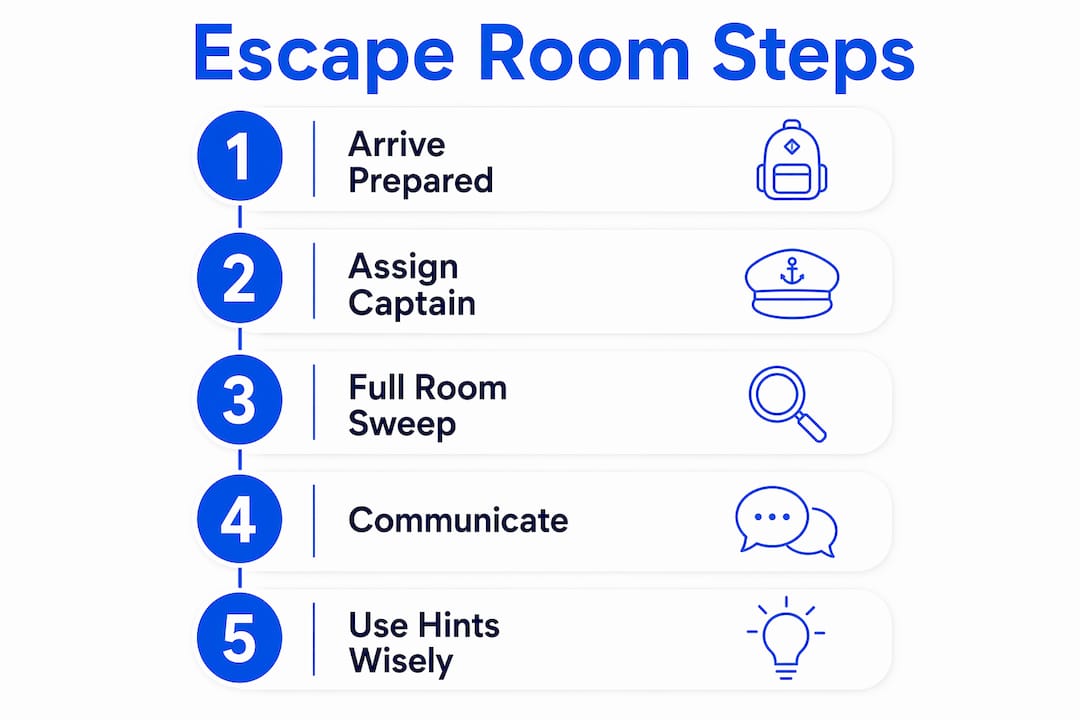
Time management in an escape room works best when treated as a resource, not a countdown. The standard room runs for 60 minutes, and most teams use 2–4 hints per session. Hints are built into the experience by design. Using them is not admitting defeat. It is playing the room the way the game master intended.
Here is how to manage both time and hints effectively:
- Ask for a hint after 8–10 minutes on the same puzzle. Sitting stuck for longer than that burns time your gang needs elsewhere. Call it in early and keep moving.
- Split into sub-teams for parallel solving. Non-linear room layouts reward teams that divide and conquer. Two pairs working separate puzzles simultaneously cover far more ground than six people huddled over one lock.
- Rotate solvers when stuck. A fresh pair of eyes on a puzzle often spots what the first solver missed. Swap in a teammate after a few minutes of no progress.
- Track your time at the halfway mark. If you are less than halfway through the puzzles at 30 minutes, call for a hint immediately and reassess your approach.
Timely hint usage is a skill, not a shortcut. The game master is your ally, not your opponent. Treat their guidance as part of the adventure.
What common mistakes should players avoid?
The most common mistake in escape rooms is overthinking. Relaxed teams notice subtle environmental details that panicked or over-analytical groups walk straight past. The simplest solution is usually the correct one. If your posse is spinning elaborate theories, step back and look for the obvious answer first.
Watch out for these frequent errors:
- Hoarding clues. One player sitting quietly with a clue in their hand while the rest of the team searches is one of the fastest ways to fail. Share everything, always.
- Ignoring the 3-second rule. When you pick up an object, evaluate it within 3 seconds to decide whether it matches a current puzzle. If it does not, set it in the central pile and move on. Do not let red herrings steal your attention.
- Crowding one puzzle. Six people staring at the same combination lock helps nobody. Spread out and trust your teammates.
- Panicking in the final ten minutes. The last stretch is where most teams fall apart. Slow down, breathe, and focus.
"Panic is the enemy of progress. The teams that escape in the final seconds are almost always the ones that stayed calm, kept communicating, and trusted the process even when the clock felt brutal."
Keeping a cool head when the pressure mounts is the mark of a truly sharp posse.
How can teams organise clues and track puzzle progress?
Clue organisation is the unsung hero of escape room success. Assigning an Inventory Manager to maintain a central unsolved pile improves escape success rates by around 40%. That is not a marginal gain. It is the difference between riding out victorious and being left in the dust.
The Inventory Manager role works best when paired with a clear system:
| Clue status | Action |
|---|---|
| Newly found | Place in the central unsolved pile immediately |
| Actively being tested | Hold in hand or keep near the relevant puzzle |
| Successfully used | Move to a separate discard pile |
| Unclear purpose | Return to the unsolved pile for later review |
This system stops your gang from re-testing used keys, re-reading solved clues, or losing track of objects that seemed irrelevant ten minutes ago but are now critical.
Pro Tip: Match each clue explicitly to a lock or puzzle before committing to it. A four-digit code that does not open the obvious lock might belong to a different puzzle entirely. Test methodically, not frantically.
Escape rooms reward systematic observation and organisation over impulsive guessing. Build the system early and your whole team benefits for the full 60 minutes.
Key takeaways
The most effective escape room strategy combines instant communication, systematic searching, and organised clue management from the very first minute.
| Point | Details |
|---|---|
| Arrive early and prepared | Get there 15 minutes before your slot to absorb the briefing fully. |
| Sweep before you solve | Complete a full room search before tackling any single puzzle. |
| Shout out every find | Verbalising discoveries immediately gives your whole team the best chance of connecting clues. |
| Use hints early | Ask for a hint after 8–10 minutes stuck. Hints are part of the experience, not a penalty. |
| Assign an Inventory Manager | A dedicated clue tracker improves escape success by around 40%. |
What I have learned watching hundreds of teams play
After watching countless groups step into escape rooms, one pattern stands out above everything else. The teams that escape are not always the cleverest. They are the ones that talk the most. Not chaotically, but constantly and usefully. Every find gets called out. Every theory gets shared. Nobody sits quietly nursing a clue.
The second pattern is harder to teach: calmness under pressure. I have seen highly capable groups fall apart in the final ten minutes because one person started rushing and the anxiety spread like wildfire. The teams that hold their nerve, keep their system running, and trust each other almost always find the exit. Sometimes with seconds to spare, but they find it.
The third thing I would tell any group heading into their first or fifth room is this: flexible roles beat rigid ones. The person who was solving puzzles brilliantly in the first half might be the one who spots the overlooked clue in the corner during the second. Let people move, adapt, and contribute wherever they can. A rigid structure where one person "leads" and everyone else follows is a recipe for a missed escape.
Enjoy the experience. The clock is part of the fun, not a threat. Your best sessions will be the ones where your posse laughed as much as they puzzled.
— Escape
Put your new skills to the test at Lvls Newcastle

Lvls Newcastle offers a range of themed escape room adventures designed for groups of all sizes and experience levels, from first-timers to seasoned veterans. The rooms are built to reward exactly the kind of communication, searching, and teamwork covered in this guide. Game masters are on hand throughout your session to keep the experience moving and the fun alive. Whether your posse is celebrating a birthday, planning a corporate outing, or simply looking for a brilliant night out in Newcastle upon Tyne, Lvls Newcastle has the adventure waiting for you. For groups who want to make a full evening of it, the venue also combines escape rooms with axe throwing, a board game café, and interactive darts all under one roof.
FAQ
What is the most important escape room tip for beginners?
Communication is the single most critical skill. Teams that verbalise every discovery immediately outperform silent groups, regardless of experience level.
How many hints should a team use in an escape room?
Most teams use 2–4 hints per session. Asking for a hint after 8–10 minutes on the same puzzle keeps the game moving and is part of the intended experience.
Should you split up in an escape room?
Yes. Most modern escape rooms are non-linear, and splitting into sub-teams to solve parallel puzzles is one of the most effective ways to beat the clock.
What is the 3-second rule in escape rooms?
The 3-second rule means evaluating any object within 3 seconds to decide whether it fits a current puzzle. If it does not, place it in the central pile and move on to avoid distraction.
How early should you arrive for an escape room?
Arrive at least 15 minutes before your booking. This gives your team time to complete the briefing and understand the rules without losing any gameplay time.