
Ready to wrangle your posse around the table without losing anyone in a rulebook stampede? Here is your quick-draw checklist to teach board games confidently, whatever the game and whoever is at the table.
Your one-sentence teach checklist: State the win condition, map one full round, walk through a single turn, flag the top two gotchas, run a dummy round, then start playing.
Time budget by game weight:
- Light games (Dobble, Sushi Go): 3–5 minutes
- Medium games (Ticket to Ride, Catan): 8–12 minutes
- Heavy games (Wingspan, Viticulture): 15–20 minutes maximum
Success metric: The first player completes their turn with confidence and the table still wants to play.
Print-and-use checklist:
- Win condition stated in one sentence
- Round structure described in three steps or fewer
- Single turn walked through with a live example
- Top two exceptions flagged (no more)
- Dummy round completed open-hand
- Questions invited before cards are drawn
That is the whole framework. Everything below is the ammunition to execute each step brilliantly.
Key takeaways
The most effective way to teach board games is to lead with the win condition, run a short dummy round, and start playing before you have covered every rule.
| Point | Details |
|---|---|
| Lead with the win condition | State how to win in one sentence before touching any component. |
| Use a layered framework | Cover theme, win condition, turn structure, then exceptions — in that order. |
| Run a dummy round | An open-hand practice turn builds confidence and surfaces questions without competitive pressure. |
| Respect the time budget | Light games: 3–5 minutes; medium: 8–12 minutes; heavy: 15–20 minutes maximum. |
| Lvls Newcastle hosted sessions | The team at Lvls Newcastle teaches and facilitates over 80 games so your group can play from the first minute. |
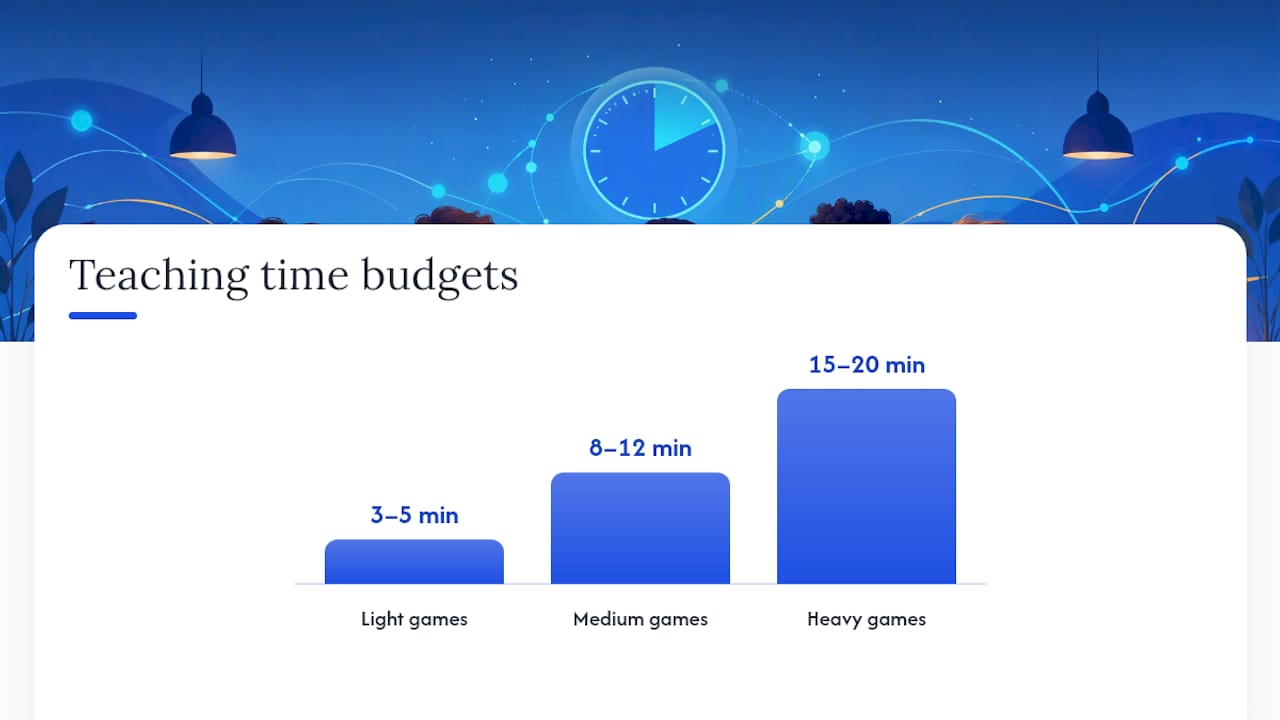
Table of Contents
- When does context about the designer or publisher actually matter?
- How do you hook players before the rules even start?
- Why you should always state the win condition first
- How to describe game flow so players can see the big picture
- Walking through a single player turn: what actually happens
- How a dummy round builds confidence fast
- Which exceptions should you mention now and which can wait?
- How to close the teach and check everyone is ready
- Teaching as you play: corrections and coaching without killing the vibe
- Rulebooks, preparation and practice: getting ready before the table fills
- Cheat-sheet: printable scripts and common pitfalls
- Keep it short, keep it social
- How to adapt your teaching style for different player types and ages
- How to keep players engaged during the teaching session
- How to break complex rules into simpler, digestible parts
- Pacing the teach to avoid overwhelming or boring players
- How to handle disputes and confusion without derailing the game
- How to get players learning by doing during the first play
- Teaching board games in a group-entertainment venue: an honest perspective
- Fancy a hosted session where someone else runs the teach?
- Sources
When does context about the designer or publisher actually matter?
Almost never. A brief historical or designer note earns its place only when it directly changes how players approach setup or strategy. If the game's unusual rule exists because the designer wanted to simulate a specific real-world system, one sentence of context can prevent ten minutes of confusion. Otherwise, skip it.
Quick decision rule: Mention context only if it changes player expectations or affects setup.
- Theme context worth stating: "This game is based on the actual 1830 railway boom, which is why you can bankrupt other players — it is meant to feel ruthless."
- Designer note worth stating: "The designer deliberately removed player elimination, so nobody sits out."
- Context to skip: Award history, publisher backstory, how many expansions exist.
Pro Tip: If you catch yourself saying "just a bit of background…" before a sentence, cut it. Players want to play, not attend a lecture.
How do you hook players before the rules even start?
The first thirty seconds of a teach sets the emotional temperature for the whole session. A short thematic hook raises curiosity and primes players to absorb rules because they already want to know how to win the story. Starting with setup narration is one of the most common ways to lose the table before the game has even begun.
Hook examples by group type:
- Casual friends: "You are all rival spice traders trying to corner the market before the season ends. First one to fill their ship wins."
- Family with children: "Imagine you are building the world's best zoo. Every animal you collect scores points, but you need the right habitat or they escape!"
- Experienced gamers: "Worker placement, asymmetric powers, engine building. The twist is that the action spaces shift every round."
Notice the pattern: theme for casual and family groups, mechanics for experienced ones. Experienced players find thematic preamble condescending; newer players find mechanical jargon alienating. Read the table and pitch accordingly.
Pro Tip: Replace "the goal of this game is…" with "you win by…" — it sounds like a challenge rather than a lesson, and players lean in rather than zone out.
Why you should always state the win condition first
The win condition is the single best anchor for every rule that follows. When players know they are racing to collect sets, everything about card drafting makes sense. When they know they are eliminating opponents, combat rules feel purposeful rather than arbitrary. Beginning with the win condition and a brief thematic premise is the most reliable way to anchor subsequent rule explanations.
One-sentence templates by win type:
- Points: "The player with the most victory points when the deck runs out wins."
- Last person standing: "You win by being the last player with health remaining."
- Set collection: "First to complete three full sets of coloured cards wins."
- Race: "First player to move their token to the final space takes the game."
State the win condition before you touch a single component. Then every rule you explain has a reason — players can ask themselves "does this help me win?" and the answer orients them immediately.
How to describe game flow so players can see the big picture
Three sentences is the target for describing a game's rhythm. Players do not need a full rulebook summary; they need a mental map they can hang individual rules on. A layered framework covering theme, win condition, turn structure and exceptions helps teachers convey even complex games quickly and consistently.
Numbered round flow template:
- Start of round: Any upkeep, card draws or resource income happens here.
- Player turns: Each player takes their turn in clockwise order.
- End of round: Scoring, round tracking or board reset occurs.
- Endgame trigger: Play continues until a specific condition is met (deck empty, token reaches end, timer runs out).
Example walk-through for a typical turn-based game: "At the start of each round, everyone draws two cards. Then, going clockwise, each player takes a full turn. After everyone has gone, we score any completed objectives and flip the round marker. When the last card is drawn from the deck, the round finishes and we count final points."
That is it. Thirty seconds. Players now have the skeleton; the flesh comes from the next step.
Walking through a single player turn: what actually happens
This is the step most teachers rush and most players need most. Break a turn into a clear sequence and players can self-manage from turn two onwards.
Turn-structure checklist:
- What happens at the start of a turn (draw, gain resources, refresh)
- The main action or actions available
- Any mandatory end-of-turn steps (discard, move a marker, pass)
Common action types explained in one line each:
- Move: "Move your token up to X spaces along the path."
- Build/place: "Place one of your pieces on any empty space."
- Draw: "Take the top card from the deck or pick from the face-up options."
- Attack/challenge: "Choose an opponent's piece and roll to resolve the conflict."
- Trade: "Swap resources with the bank or another player at the listed rate."
Pro Tip: Demonstrate the turn on your own hand, face up, while narrating each step aloud. Players absorb a shown turn far faster than a described one.
How a dummy round builds confidence fast
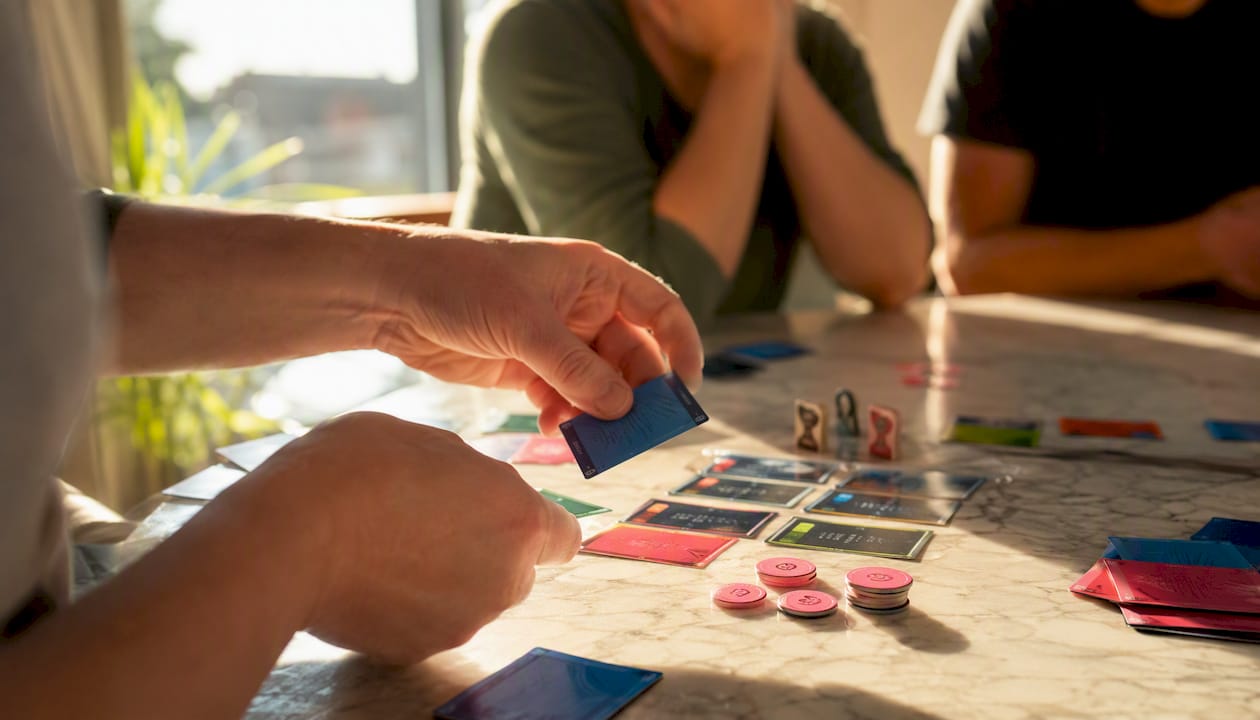
A dummy round — sometimes called an open-hand demonstration — is one of the most effective tools you have. Running an open-hand demo builds player confidence and creates a natural moment for questions without competitive pressure. Nobody is losing points; everyone is watching and learning.
How to run it, step by step:
- Announce it clearly: "We are going to play one practice turn together. Nothing counts."
- Lay your hand or resources face-up on the table so everyone can see your options.
- Narrate every decision: "I could move here, but I am going to place a worker instead because it gets me the resource I need for next turn."
- Invite the next player to take a practice turn with the same narration.
- Stop after one full round. Do not extend it into a second practice round.
Dos and don'ts:
- Do keep the demo to one round maximum.
- Do explain the why behind each choice, not just the what.
- Do invite questions after each player's practice turn, not all at once at the end.
- Don't cover every edge case during the demo — save exceptions for when they arise.
- Don't let the demo become a second teach. One round, then play.
Village Meeple's guidance makes the point well: no one wins the demo game, and setting that expectation openly reduces anxiety and raises engagement across the whole table.
Pro Tip: If someone interrupts the demo with a rules question, answer it in one sentence and move on. Longer answers derail the flow and signal that the game is complicated — even when it is not.
Which exceptions should you mention now and which can wait?
Not every rule needs to be in the teach. The art is knowing what to front-load and what to save for the moment it actually comes up.
| Exception type | When to mention it |
|---|---|
| Rules that affect every player every turn | Mention now |
| Rules that affect setup or starting resources | Mention now |
| Tie-breaker rules | Mention on first occurrence |
| Rare card or space effects | Mention on first occurrence |
| Edge cases that may never happen | Ignore unless asked |
| Advanced variant rules | Ignore unless asked |
Common gotchas worth flagging upfront:
- Turn limits: "You can only take two actions per turn, not as many as you like."
- Hand limits: "You must discard down to five cards at the end of your turn."
- Blocking rules: "You cannot place a worker on a space already occupied."
When you do flag an exception, keep it to one sentence: "One thing to know: you cannot do X and Y in the same turn." Short, specific, and move on. Anything longer sounds like a warning label rather than a rule.
How to close the teach and check everyone is ready
A clean close is as important as a clean open. Announcing a short roadmap at the start and summarising at the end both reduce interruptions and improve comprehension.
Two-line summary template: "So: you win by [win condition]. On your turn you [main action]. The one thing to remember is [top gotcha]. Any questions before we start?"
Three targeted question prompts to check comprehension:
- "Can someone tell me what happens at the end of their turn?" (checks turn structure)
- "What would you do if you wanted to score points right now?" (checks win-condition understanding)
- "What happens when the deck runs out?" (checks endgame trigger)
Read the table after asking. Blank faces mean confusion, not shyness. If two or more players look uncertain, run one more practice turn rather than starting the game proper. One extra minute here saves five minutes of mid-game confusion later.
Teaching as you play: corrections and coaching without killing the vibe
The first two rounds of any game are live teaching time. Practised demonstrators stop explaining before covering every edge case and let the game teach the remaining rules. The same principle applies at your table.
In-game correction dos and don'ts:
- Do wait until a player has finished their thought before correcting.
- Do frame corrections as options: "You can also do X — want to try that instead?"
- Do explain the why: "That move would leave you open to losing your resource next turn."
- Don't correct every suboptimal play — let players discover strategy themselves.
- Don't pause the game for a correction unless the mistake would affect scoring or another player's turn.
Gentle nudges that work: "Have you thought about what happens if you do that next turn?" or "There is another option on your card — worth a look." These prompt thinking without handing over the answer.
When to fully pause: if a player takes an action that is physically impossible under the rules, stop briefly, fix it in one sentence, and restart. Keep the pause under thirty seconds. Longer pauses break momentum and make the error feel bigger than it is.
Rulebooks, preparation and practice: getting ready before the table fills
Writing a one-page teach summary covering goal, turn structure, top decisions and common gotchas is one of the most reliable ways to prepare. Read the rulebook once in full, then write your summary from memory. Gaps in your summary reveal gaps in your understanding before the table fills.
Preparation checklist:
- Read the full rulebook at least once before the session.
- Write a one-page teach script: win condition, round flow, turn steps, top three gotchas.
- Create a simple player aid card showing turn structure and common icons.
- Run through the dummy round aloud to yourself at least once.
- Play a solo mock turn to confirm you know the sequence without checking the rulebook.
Player aid cards cut in-play clarifications dramatically. A small card showing "1. Draw 2. Play 3. Discard" at each player's seat means they can self-check rather than ask the teacher after every action. Involving players in setup — asking them to sort components or shuffle their deck — also builds familiarity with the pieces before a single rule is explained.
Cheat-sheet: printable scripts and common pitfalls
Printable teach checklist
- Win condition (one sentence)
- Round structure (three steps)
- Turn steps (numbered, max five)
- Top three gotchas
- Dummy round (one practice turn, open-hand)
- Summary + questions
Three sample teach scripts
Casual friends (under 10 minutes): "You are all competing to score the most points before the deck runs out. Each turn: draw a card, play a card, discard down to five. The big rule: you can only play one card per turn. Let us do one practice round together, cards face up, then we are off."
Families with children: "We are building the best zoo! Every animal card you collect scores points at the end. On your turn, pick one card from the middle or draw from the pile. If you get a matching habitat, you score double. Let us try one turn together so everyone can see how it works."
Experienced gamers: "Worker placement, two actions per turn, asymmetric starting powers. Endgame triggers when the supply runs out. I will walk through one turn quickly — you will pick up the rest as we play. Any questions on the core loop before we start?"
Common pitfalls and short fixes
- Over-explaining: If your teach runs past the time budget, stop mid-sentence and start playing. The game will fill the gaps.
- Covering every exception upfront: Flag only the two rules that affect every player every turn. Save the rest.
- Reading from the rulebook: Use your one-page script instead. Rulebook language is written for reference, not for teaching.
- Ignoring confused faces: Pause, ask one targeted question, and answer it. Do not barrel on.
Venue note: Hosted sessions like those at Lvls Newcastle benefit from a two-person approach: one host runs the demo while a second monitors the table for confusion and fields questions quietly. Advanced demonstrators use practised lines and deliberate staging to keep attention in noisy environments — the same techniques that work in a busy café work equally well at a lively game night.
Keep it short, keep it social
The one-line success metric: the first player completes their turn confidently and the table wants to keep playing.
That is the only benchmark that matters. Not whether every rule was covered. Not whether anyone played optimally. Just: did the first turn happen smoothly, and is the energy still good?
- Keep teaches short — stop before you think you are done.
- Keep them social — involve players in setup and the dummy round.
- Keep them forgiving — mistakes in the first game are part of the fun, not failures.
A short teach that gets people playing beats a thorough teach that gets people yawning every single time.
How to adapt your teaching style for different player types and ages
No two groups are the same, and a teach that lands brilliantly with a group of seasoned hobby gamers can completely derail a family afternoon. The fix is reading the table before you open your mouth.
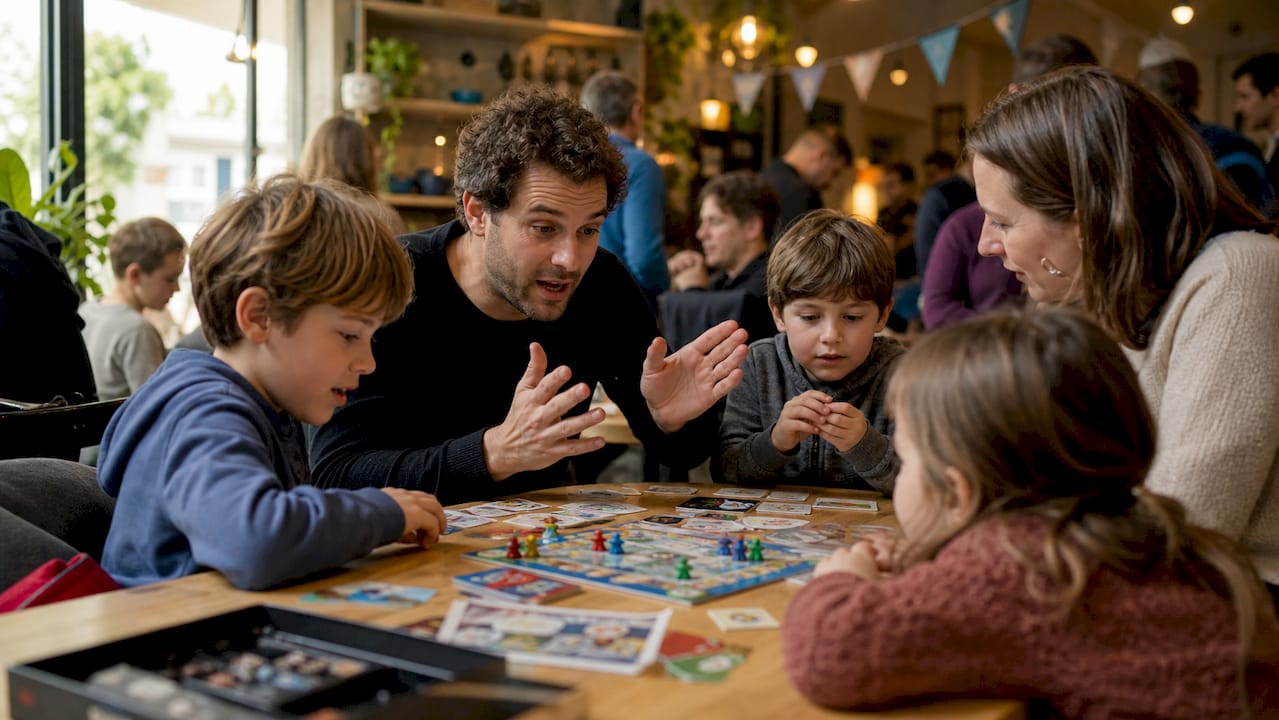
Children and mixed-age families: Lead with the story, not the rules. Children engage with narrative and visual components far more readily than abstract mechanics. Keep the teach under five minutes, use the components as props during the explanation, and let children handle their own pieces from the start. Family-friendly games with simple iconography and short turns are the easiest to teach because the game itself reinforces the rules within two or three turns.
Teenagers and young adults: This group tends to be competitive and quick. They often prefer a shorter teach followed by learning through play. Give them the win condition, the turn structure, and one key strategic tip, then start. They will ask questions when they need to, and they respond well to being trusted to figure things out.
Complete beginners: Slow down the dummy round and narrate every decision. Avoid jargon entirely — "hand limit" becomes "you can only hold five cards", "worker placement" becomes "you put your piece on a space to claim an action." The goal is zero confusion before the first real turn.
Experienced gamers: Skip the theme, lead with the mechanical hook, and flag only the rules that differ from games they already know. Phrases like "it works like Catan but the trading is blind" save two minutes of explanation instantly.
How to keep players engaged during the teaching session
Attention drifts fast when someone is talking and nobody is doing anything. The best teaches are short precisely because they respect that limit.
Give players something to hold or sort while you talk. Shuffling a personal deck, arranging starting resources, or reading a role card keeps hands busy and minds present. Involving players in setup is not just a kindness — it is a kinetic icebreaker that builds familiarity with components before a single rule lands.
Vary your pace deliberately. Spend ten seconds on a simple rule, thirty on a complex one. A flat, even delivery signals that everything is equally important, which means nothing stands out. Punch the key rules with a short pause before and after: "The one rule that catches everyone out… you can only take two actions per turn. Not three. Two."
Eye contact matters. Scan the table every thirty seconds. If someone is looking at their phone, speed up or ask them a direct question. If someone looks confused, slow down and check in. The teach is a live performance, and the audience tells you how it is going.
How to break complex rules into simpler, digestible parts
Heavy games feel heavy mostly because teachers try to explain everything at once. The solution is sequencing, not simplification.
Start with the skeleton: win condition, round structure, one turn. Then add one layer at a time, only when it is relevant. Teaching in a layered framework — theme, win condition, turn structure, exceptions — means players absorb each layer before the next one arrives.
Analogies cut through complexity faster than definitions. "Your workers are like employees — once you send them to a space, they are busy until you call them back at the end of the round." That one sentence replaces a paragraph of rulebook text. Find the real-world parallel for each mechanic and use it.
Break multi-step actions into numbered sub-steps and say the number aloud: "Step one, pick a location. Step two, pay the cost. Step three, take the reward." Numbered sequences are easier to remember than flowing prose because players can count their way through the first few turns.
Pacing the teach to avoid overwhelming or boring players
The teach should feel like a trailer, not the film. Your job is to give players just enough to start, not everything they will ever need to know.
A useful rule of thumb: if the teach is taking longer than the first round of play would take, it is too long. Stop, start playing, and handle the remaining rules as they arise. Practised demonstrators consistently favour starting play early and letting the game teach the rest.
Boredom and overwhelm have the same root cause: too much information delivered passively. The antidote is interaction. Ask a question every two minutes. "So, based on that, what would you do on your first turn?" A player who has answered a question is a player who is still with you.
Watch for the moment the table starts fidgeting. That is your cue to wrap up and start. A game that begins with a slightly confused table is almost always more fun than one that begins with an exhausted one.
How to handle disputes and confusion without derailing the game
Disputes happen. The key is resolving them quickly and without drama so the energy stays high.
For rules confusion, go to the rulebook index, find the answer in under a minute, and state it plainly. If the rulebook is ambiguous, make a group decision, note it, and move on. Do not spend more than ninety seconds on any single dispute during the first game.
For disagreements between players about strategy or fairness, separate the rule question from the opinion question. "The rule says X" is a fact. "That was a bad move" is an opinion. Settle the fact, leave the opinion alone.
A useful phrase for any dispute: "Let us make a call for now and check the rulebook properly at the end of the round." This keeps the game moving and signals that accuracy matters without letting it grind everything to a halt. Most disputes feel smaller after a round of play than they did in the moment.
How to get players learning by doing during the first play
The first game is not about winning. It is about building the muscle memory to play confidently next time. Setting that expectation openly reduces anxiety and encourages players to try things rather than freeze.
Encourage experimentation explicitly: "Try the move even if you are not sure it is optimal — we will see what happens." Players who are given permission to make mistakes make better decisions faster than players who are afraid of getting it wrong.
Coach strategy lightly during the first play. Not "do this" but "have you considered what happens if you do that?" The difference is ownership. A player who discovers a strategy themselves will remember it; a player who was told what to do will ask again next game.
After the first game, spend two minutes on a debrief: what worked, what surprised people, what they would do differently. That conversation is where the real learning happens, and it sets up the next game to be genuinely competitive.
Teaching board games in a group-entertainment venue: an honest perspective
Running a teach in a venue is a different beast from running one at home. The noise level is higher, the group turnover is faster, and the players in front of you have often never met each other before. A teach that works perfectly in a quiet living room can fall apart in a busy café if you have not adjusted for the environment.
The biggest difference is attention span. At home, players have chosen to be there and are invested before you start. In a venue, they are still arriving, still ordering drinks, still getting comfortable. The teach needs to be shorter and punchier than you think, and it needs to start with something that grabs attention rather than assuming it.
Large groups present a specific challenge: the further a player sits from the teacher, the less they absorb. A two-person approach works well here — one host runs the demo at the centre of the table while a second moves around the outside, checking in with players who look lost and answering quiet questions without interrupting the main teach. For large group sessions, quick reference cards at each seat are not optional; they are the difference between a smooth first round and five minutes of repeated questions.
The other venue-specific reality is mixed ability. A group of eight at a café might include two hobby gamers, three people who last played Monopoly in 2015, and three who have never played a modern board game. Pitch the teach at the least experienced player, give the experienced ones a nod ("you will recognise the worker placement mechanic"), and trust the game to do the rest.
Fancy a hosted session where someone else runs the teach?
Lvls Newcastle's board game café holds a library of over 80 games, and the team there handles the teach so your group can focus on playing. No prep, no rulebook panic, no one person carrying the whole session.

For birthdays, corporate team-building, stag and hen parties, or a casual group night out in Newcastle, Lvls Newcastle sets up the game, walks your group through the rules, and keeps the session moving at the right pace for your crew. Mixed abilities, large groups, first-timers — the team has seen it all and knows how to get everyone playing confidently within minutes. Check availability and book your group session today, or explore the full range of group activities including escape rooms and axe throwing for a full night of adventure.
Sources
Short annotations to help you go deeper on specific techniques:
- Tips for teaching new board games to friends and strangers
- How to Teach a Board Game Without Losing Your Table - Lets Play Games
- Tips on How to Teach a Board Game — Village Meeple Board Game Cafe
- How to Teach Someone a Board Game (and Even Have Fun Doing It)
- How to Teach Any Board Game in 5 Minutes: A Clear Step-by-Step Framework – BoxKing
- How To Teach Board Games Like a Pro
Use rulebooks as a reference, not a script. Read them once to understand the game, write your own teach from memory, and return to the rulebook only when a specific question arises during play.