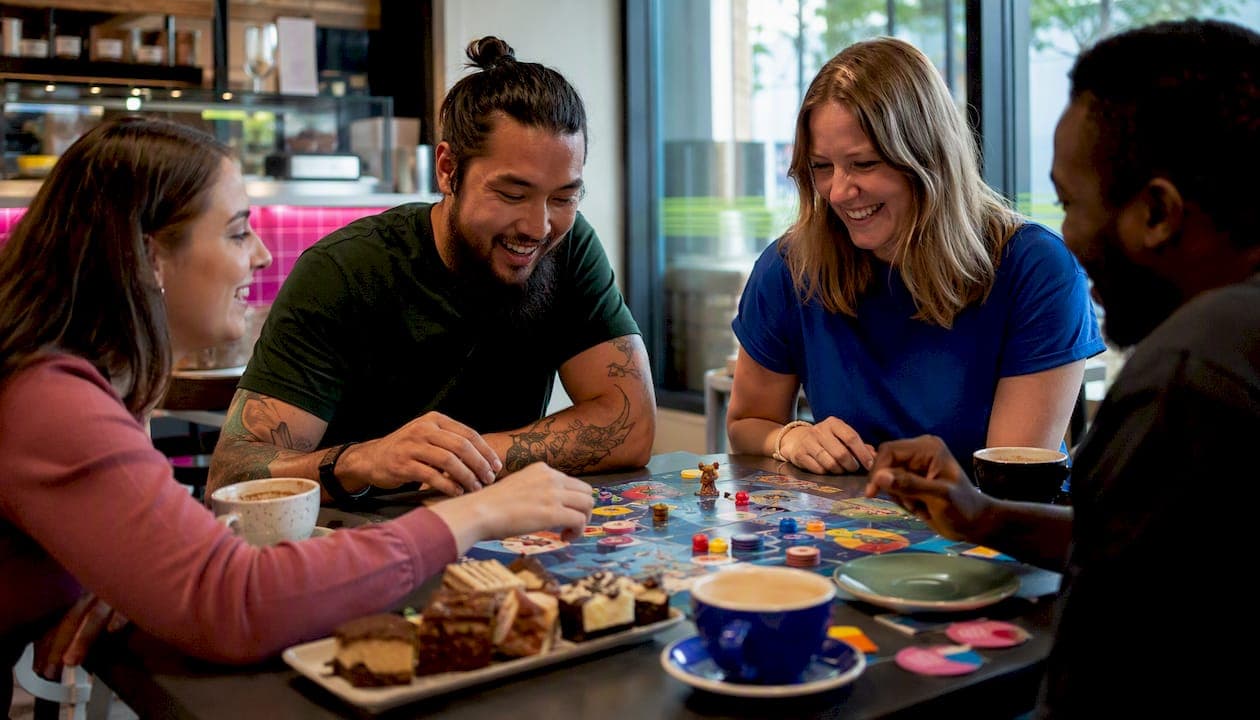
For corporate team building, cooperative board games deliver the strongest outcomes: Pandemic for trust and communication, Codenames for icebreakers, Captain Sonar for large-group strategy, and Just One for quick social bonding. Pick your goal first, then your game.
Quick picks by goal:
- Icebreaker / social warmup: Codenames, Just One, Pictionary / Articulate
- Communication and trust: Pandemic, Mysterium / Mysterium Park, Hanabi
- Decision-making under pressure: Captain Sonar, Betrayal at House on the Hill
- Large groups (10+): Captain Sonar, Codenames (team format), Articulate
TL;DR: Set your objective, pick the matching category, run a 30–45 minute session, then spend at least 30 minutes on a structured debrief. That sequence is where the real workplace value lives.
Table of Contents
- Why do board games actually work for team building?
- How do you choose the right game for your event goal?
- What are the best team building board games by category?
- How do you run a board-game team-building session well?
- Where can you source games or book a venue in the UK?
- What mistakes do most organisers make with team building games?
- Does a hosted venue actually improve outcomes?
- Key takeaways
- The gap between a fun afternoon and a useful one
- Lvls Newcastle corporate packages: what's included
- Useful sources and further reading
Why do board games actually work for team building?
The short answer: they create a non-risk environment where your posse can practise high-pressure decisions, sharpen communication, and build empathy without any real-world consequences. Nobody loses a client. Nobody misses a deadline. But the dynamics that play out around the table? Those are completely real.
Industry guidance from Asmodee UK maps the mechanism neatly: cooperative games build communication and shared problem-solving, while party games accelerate social bonding and break down hierarchical awkwardness. The category you choose shapes the outcome before a single card is drawn.
Three core mechanisms make this work in a corporate setting:
- Shared goal structures force cross-functional collaboration, not just parallel working.
- Time-limited decision-making surfaces who leads, who defers, and who goes quiet under pressure.
- Psychological safety is baked in because the stakes are low and the tone is playful.
Statistic callout: Facilitated training-game vendors recommend a 30–60 minute debrief to translate play into concrete workplace action items. The game is the catalyst; the debrief is where the learning actually sticks.
Pro Tip: Don't skip the debrief to squeeze in another round. One well-facilitated 40-minute debrief produces more transferable insight than three extra games.
How do you choose the right game for your event goal?
Start with the objective, not the box art. A game that looks brilliant on the shelf can completely miss the mark if it doesn't match what your team actually needs that day.
Decision flow:
- Define the goal. Trust? Communication? Icebreaker? Decision-making under pressure?
- Check group size and accessibility. Some games cap at six players; others scale to twenty.
- Pick the cooperation level. Fully cooperative beats competitive for mixed-seniority groups.
- Check the learning curve. Rule-heavy games lose non-hobbyists in the first ten minutes.
- Plan the debrief. Budget at least 30 minutes after play ends.
Practical constraints checklist:
- Time: Under 60 minutes total? Stick to party games (Just One, Codenames). Got 90 minutes? Pandemic or Captain Sonar work well.
- Space: Large tables and good lighting matter more than most organisers expect.
- Noise: Captain Sonar is loud by design. Hanabi requires near-silence. Know your room.
- Accessibility: Avoid language-heavy games for multilingual teams; prioritise visual or symbol-based mechanics.
- Experience mix: Cooperative titles reduce competitive silos and encourage shared accountability in mixed-experience groups.
For large groups, split into tables of four to six and run simultaneous games, then rotate every 30–35 minutes. Simplified rule sets are not cheating; they're good facilitation.
What are the best team building board games by category?
Here's the shortlist your posse needs, organised by category. Each game earns its place because it teaches something transferable, not just because it's fun.
Cooperative games
Pandemic puts every player on the same side against a global disease outbreak. Players must share information, divide tasks, and make collective decisions under time pressure. It's the gold standard for demonstrating that hoarding information kills the team. Group size suitable for small teams; duration typically under an hour. Learning curve is moderate. Widely available across UK retailers.
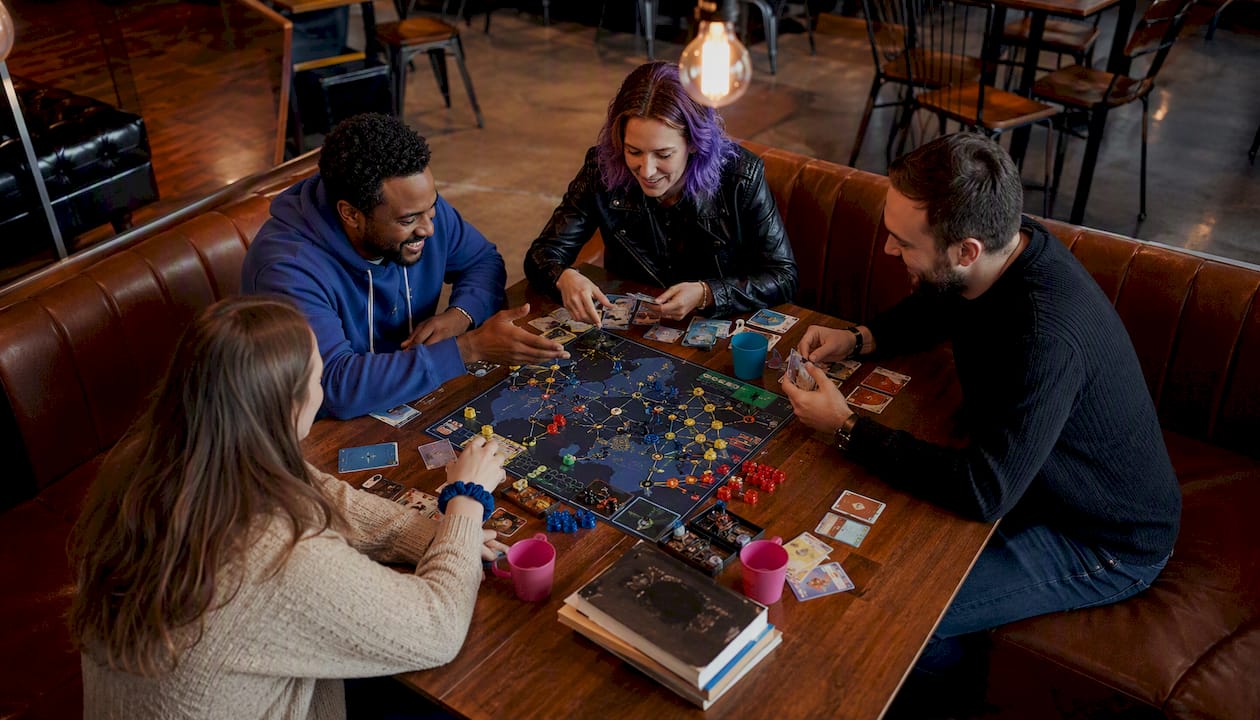
Hanabi is deceptively simple: you hold your cards facing outward so everyone else can see them except you. Players give each other limited clues to build a fireworks sequence in order. The mechanic forces precise, economical communication and active listening. Group size fits small teams; duration is short. Learning curve is low. Available at a low price point.
Mysterium / Mysterium Park casts one player as a ghost communicating through abstract vision cards, while the rest interpret the imagery to solve a mystery. It's a brilliant trust exercise because the ghost cannot speak, only gesture and share cards. Suited for small to mid-sized groups; typical playtime under an hour. Learning curve ranges from low to moderate.
Party and icebreaker games
Codenames splits your group into two teams, each guided by a spymaster giving one-word clues to link multiple words on a grid. It's quick to learn, scales well in team format, and surfaces how differently people make associations. Check out our icebreaker games guide for warm-up variations. Suitable for teams of various sizes; short duration; very low learning curve. Note: requires reasonable English word familiarity, so less ideal for multilingual teams.
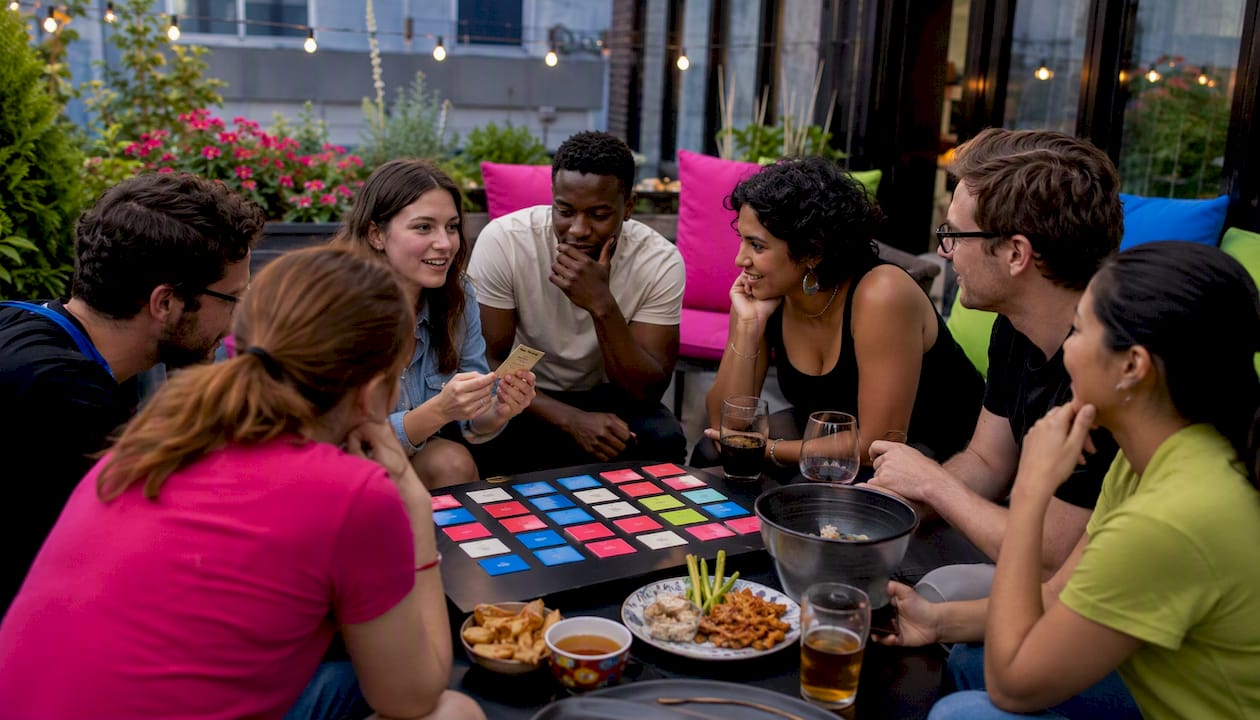
Just One is a cooperative word-guessing game where everyone writes a one-word clue simultaneously, then duplicate clues are eliminated before the guesser sees them. It rewards creative thinking and penalises groupthink. Fits small groups; brief sessions; minimal learning curve.
Pictionary / Articulate need no introduction in most UK offices. Articulate in particular works brilliantly for large groups because it's fast, loud, and requires no reading. Accommodates large groups; short to moderate duration; requires no learning curve. For more on party-style board games that scale for bigger groups, the options are wider than most organisers realise.
Strategic and large-group titles
Captain Sonar simulates two submarine crews hunting each other in real time. Each player has a fixed role: captain, first mate, radio operator, or engineer. Escape-room style time pressure forces rapid role negotiation and information sharing across the table. It's genuinely chaotic in the best possible way. Designed for groups of several players; moderate session length; moderate learning curve.
Betrayal at House on the Hill starts as a cooperative exploration game, then mid-game one player becomes a traitor. It's the most complex title on this list and works best with self-selecting groups who enjoy narrative games. Intended for small groups; longer session duration; steep learning curve. For large group board game formats in Newcastle, rotation-based play keeps everyone involved.
Quick comparison table
| Game | Best for | Group size | Duration | Learning curve | Cooperation level | Setup complexity | UK availability |
|---|---|---|---|---|---|---|---|
| Codenames | Icebreaker | 4–6 | 20–30 min | Very low | Competitive teams | Minimal | Widely available, ~£20 |
| Pandemic | Trust / communication | 2–4 | 45–60 min | Moderate | Fully cooperative | Moderate | Widely available, ~£30–£40 |
| Just One | Social bonding | 3–7 | 20–30 min | Minimal | Fully cooperative | Minimal | Widely available, ~£15 |
| Hanabi | Communication | 2–5 | 30 min | Low | Fully cooperative | Minimal | Widely available, ~£10–£15 |
| Mysterium | Trust / empathy | 2–7 | 45–60 min | Low–moderate | Fully cooperative | Moderate | Widely available, ~£30 |
| Captain Sonar | Decision-making | 2–6 | 30–45 min | Moderate | Team vs team | Moderate | Specialist/online, ~£35 |
| Betrayal at House | Decision-making | 3–6 | 60–90 min | High | Cooperative then traitor | Complex | Specialist/online, ~£40 |
| Pictionary / Articulate | Icebreaker / large group | 4–20+ | 30–45 min | None | Competitive teams | Minimal | Widely available, ~£20–£40 |
How do you run a board-game team-building session well?
Structure is what separates a fun afternoon from a session that actually changes how your team works. Here's a timing template that holds up in practice.
Sample 90-minute session plan:
- 0–10 min: Welcome and framing. State the goal in one sentence. "Today we're looking at how we share information under pressure." Don't over-explain.
- 10–20 min: Rules and setup. Keep this tight. Use a 'rule rescuer' volunteer per table to field questions during play rather than pausing the whole group.
- 20–55 min: Play. Run one or two rounds. Observe without intervening unless the group is completely stuck.
- 55–60 min: Pause and reflect individually. Ask each player to write down one moment where communication broke down and one where it worked.
- 60–90 min: Facilitated debrief. This is the session's engine.
Facilitation checklist:
- Brief the group on psychological safety before play starts: "There are no wrong moves here."
- Assign a rule rescuer per table, not a rules police officer. The distinction matters.
- Watch for dominant players in the first 10–15 minutes before introducing any formal roles. Observing natural dynamics first produces better role assignments than pre-allocating them.
- For groups of 10+, run simultaneous tables and rotate every 30–35 minutes.
- Keep a visible timer. Time pressure is part of the learning.
Debrief questions that transfer to the workplace:
- "When did the team's communication break down? What triggered it?"
- "Who took the lead? Was that the expected person?"
- "Where did you hold back information? Why?"
- "What would you do differently in the first five minutes of a real project?"
- "Which decision felt most uncomfortable? How did you resolve it?"
- "Did anyone feel unheard? What would have helped?"
The post-game debrief is where learning transfers into workplace action. Aim for 3–5 named action items with owners before the session closes.
Where can you source games or book a venue in the UK?
Three routes, each with a different trade-off for your posse.
Buy your own games. Works well for teams that run regular sessions. UK retailers including Waterstones, Zatu Games, and Amazon stock most titles on this list. Budget roughly £10–£40 per game. The upside is reusability; the downside is storage, setup time, and the absence of a facilitator.
Borrow or bring from a library. Some UK public libraries and community spaces stock board games. Borrowing cuts cost but limits selection and condition.
Book a board game café or hosted venue. This is the strongest option for one-off corporate events. A good venue provides the game library, tables, facilitation support, and often food and drink, removing almost all organisational friction. Structured play with a facilitator produces higher-quality debriefs and clearer post-session action plans than self-run sessions.
Price callout: Buying a starter kit of four to five popular games is affordable and accessible from UK retailers. A hosted corporate session at a board game café has a per-person cost that varies by group size and package inclusions, with typical pricing available from venues.
Practical kit to bring if you're running your own session:
- A countdown timer (phone works fine)
- Note paper and pens for each player
- Printed one-page rule summaries for each game
- A seating plan for groups over 12
- Spare score sheets or tracking cards
Pro Tip: Weekday daytime slots at board game cafés often cost less than weekend evening bookings and come with quieter rooms. If your team is in the office on a Wednesday, that's your sweet spot.
For a broader view of corporate entertainment options beyond board games, mixing activities keeps energy high across longer events.
What mistakes do most organisers make with team building games?
A few predictable errors keep showing up, and every one of them has a quick fix.
- Choosing a game that's too complex. High-complexity strategic games cause analysis paralysis for non-hobbyists. Betrayal at House on the Hill is brilliant, but not for a group that's never played a modern board game. Fix: default to low-learning-curve titles unless the group self-selects for complexity.
- Skipping the debrief. The game without the debrief is just a game. Fix: protect the debrief time in the calendar before the session starts, not after.
- Over-emphasising competition. Leaderboards and prizes shift focus from collaboration to winning. Fix: use fully cooperative games or frame competitive games around team scores rather than individual performance.
- Ignoring accessibility and language needs. Word-heavy games like Codenames disadvantage non-native English speakers. Fix: check your participant list and swap to visual or symbol-based mechanics where needed.
- Poor room layout. Cramped tables, bad lighting, and background noise kill concentration. Fix: visit the room in advance and set up tables for groups of four to six with clear sightlines.
- Assigning roles before observing dynamics. Forcing someone into a leadership role they wouldn't naturally take creates resistance. Fix: watch for 10–15 minutes, then introduce roles only if the group is drifting.
Pro Tip: Keep a 'rule rescuer' volunteer at each table rather than having the facilitator patrol the room. One knowledgeable person per table keeps play flowing without breaking the group's momentum.
Does a hosted venue actually improve outcomes?
Short answer: yes, and the difference shows up most clearly in the debrief. Real events with an experienced facilitator produce higher-quality debriefs and clearer post-session action plans than self-run sessions, because the facilitator can observe the whole room, not just their own table.
A hosted venue also removes the logistical friction that quietly derails DIY sessions: sourcing games, setting up tables, managing timekeeping, and handling the inevitable rules dispute. When those tasks belong to the venue, the organiser can focus entirely on the group.
Questions to ask when booking a corporate venue:
- What is the maximum group capacity for a seated board-game session?
- Do you provide a dedicated facilitator, or is facilitation self-managed?
- What does the game library include, and can you curate a selection for our goal?
- Are food and drink included, or available to add?
- Is the space accessible for participants with mobility or sensory needs?
- What insurance and safeguarding provisions are in place for corporate groups?
- Can you provide a structured debrief framework, or do we bring our own?
How on-site facilitation changes the debrief:
- The facilitator has observed the whole session and can reference specific moments.
- Structured action points are produced during the debrief, not reconstructed afterwards.
- Ownership assignments are made in the room, with the group present, which increases follow-through.
For escape-room style corporate formats, a hosted venue adds the additional benefit of themed environments that raise engagement before a card is even drawn.
Key takeaways
Cooperative board games matched to a clear event goal, followed by a structured 30–60 minute debrief, produce the most transferable workplace outcomes from a team-building session.
| Point | Details |
|---|---|
| Match game to goal | Choose cooperative titles for trust and communication; party games for icebreakers; strategic titles only for experienced groups. |
| Protect the debrief | Budget 30–60 minutes post-play and produce 3–5 named action items with owners before the session closes. |
| Observe before assigning roles | Watch natural dynamics for 10–15 minutes before introducing formal roles to avoid resistance. |
| Accessibility first | Check participant language and mobility needs before selecting a game; visual mechanics beat word-heavy ones for mixed groups. |
| Lvls Newcastle as hosted option | Lvls Newcastle offers a board game café with over 80 games, facilitation support, and corporate packages, removing DIY logistics entirely. |
The gap between a fun afternoon and a useful one
Most team-building sessions fail not because the game was wrong, but because the debrief was treated as optional. You can hand a group Pandemic, watch them save the world in 50 minutes, and walk away with nothing transferable if nobody asks "what just happened, and what does it tell us about how we work?"
The games on this list are genuinely good. Hanabi is one of the most elegant communication exercises ever designed. Captain Sonar under real-time pressure reveals team dynamics faster than a year of one-to-ones. But the game is only the opening act. The real work happens when the organiser asks the right questions afterwards and someone in the room says, "Actually, that's exactly what happens in our Monday stand-up."
There's also a tendency to over-engineer the selection. Organisers spend weeks researching the perfect game and then run a 20-minute debrief because they've run out of time. Flip that ratio. A simpler game with a longer, sharper debrief will almost always outperform a sophisticated one with a rushed close.
One more thing: mixed-enthusiasm groups are the norm, not the exception. Some of your posse will be all-in from the first card; others will be watching the clock. The fastest way to bring the reluctant players along is a low-learning-curve game where they can contribute immediately. Codenames or Just One will do that in under five minutes. Save the complex titles for groups that ask for them.
Lvls Newcastle corporate packages: what's included
Running a board-game session for a corporate group takes more logistics than most organisers expect. Sourcing games, setting up tables, managing timing, and facilitating a debrief simultaneously is a lot to hold together, especially for a team leader who is also a participant.
Lvls Newcastle takes that weight off your hands. The venue's board game café holds a library of over 80 games, with curated selections available for corporate groups depending on your goal. Whether your posse needs a quick icebreaker session or a full afternoon of cooperative play with a structured debrief, the space, the games, and the support are already there. Add in the option to combine board games with escape rooms or axe throwing for a mixed-activity day, and you've got a corporate event that keeps energy high from start to finish.
Corporate packages are customisable for group size, duration, and activity mix, with food and drink options available on-site. Hosted sessions mean your facilitator can focus on the group rather than the logistics, and the debrief happens in a dedicated space rather than a cleared-out meeting room.
Book your corporate session at Lvls Newcastle or enquire about packages for groups of any size.
Useful sources and further reading
A short list of credible resources for organisers planning board-game team-building sessions in the UK.
- Asmodee UK: Corporate Team Building Using Board Games — Publisher guidance on matching game categories to corporate goals; UK-relevant and regularly updated.
- Business Excellence Institute: APEX Board Game — Explains the non-risk learning environment mechanism and how board games support decision-making and communication skills.
- Company Culture Game: Traction Not Transaction — Practitioner resource on debrief structure and converting play into workplace action items.
- Surf Office: 14 Board Games for Team Building — Curated list of accessible titles commonly recommended for workplace events, with brief facilitation notes.
- Timbervault: Super Team Roles in Escape Rooms — Practical guidance on observing natural team dynamics before assigning roles; transferable to board-game facilitation.
- Lvls Newcastle: Team Building Escape Room Guide — Overview of escape-room style activities and facilitation best practice for corporate groups in Newcastle.
- Lvls Newcastle: Large Group Board Games Guide — Practical guidance on running board-game activities with larger corporate groups, including rotation formats.
- Lvls Newcastle: Book Your Corporate Session — Main venue landing page for enquiries and bookings; corporate packages available for groups of all sizes.